

Mathematisch-Naturwissenschaftliche Fakultät: Suche
Anzeige der Dokumente 1-10 von 236
Jet-Reorientation in X-shaped Radio Galaxies
(2002)
The thesis set out to investigate the nature and genesis of the peculiar class of X-shaped radio galaxies. X-shaped sources are puzzling because of the extremely low number of objects of that type. Three scenarios were ...
Modeling of the Near Infrared Emission From the Peculiar B[e]-Star MWC349
(2000)
The aim of this thesis is to investigate the first overtone band emission of CO from the peculiar B[e] star MWC 349. With the United Kingdom Infrared Telescope (UKIRT) in Hawaii, low resolution observations were made to ...
The Huygens Doppler Wind Experiment: a Titan Zonal Wind Retrieval Algorithm
(2002)
The Cassini/Huygens mission to Saturn, a joint venture of NASA and ESA, was launched on 15 October 1997 from Kennedy Space Center, Cape Canevaral, Florida (USA) and will reach its destination in July 2004. The Huygens Probe ...
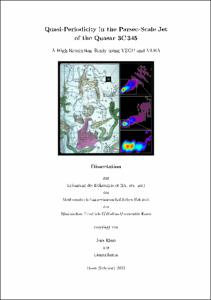
Quasi-Periodicity in the Parsec-Scale Jet of the Quasar 3C 345: A high resolution study using VSOP and VLBA
(2003)
We have observed the Quasar 3C345 with VSOP and the VLBA at four different frequencies (1.6GHz, 5GHz, 22GHz and 43GHz), making a total of 24 epochs, from 1997.40 to 1999.69. This study, combined with previous observations, ...

PolKa: a Polarimeter for Submillimeter Bolometer Arrays
(2003)
Starting from measurements of the linear polarization of the radiation emitted by celestial objects it is possible to estimate some physical parameters of the source. For example, magnetic field intensities and directions ...
Multi-frequency analysis of intraday variable radio sources
(2003)
Active Galactic Nuclei (AGN) are known to show significant flux density variability across the whole electromagnetic spectrum on a wide range of time scales, from years to less than one day. In the radio regime, variability ...
A noise reduction method based upon statistical analysis for the detection of weak signals in discrete data
(2003)
While searching sets of discrete data contaminated heavily by noise for weak signals of correlated data points we have made use of statistic quantities to detect correlations between data points. The signal consists of ...

HUMBA: the Hundred Millikelvin Bolometer Array for 2 mm Continuum Observations
(2003)
High resolution maps of the Sunyaev-Zel'dovich effect in clusters of galaxies offer a powerful tool for studying physics in clusters and cosmology. The Hundred Millikelvin Bolometer Array (HUMBA) for 2 mm continuum observation ...

Zeeman Measurements using SO (10-01) Transition and Heterodyne Observations towards the W51 Region
(2003)
Understanding the star-forming procedure is one of the most important topic in astrophysics. One of the most unexplored fields in the star-forming theories is magnetic field. Magnetic field is believed to play an important ...
Lidarbeobachtungen der polaren Atmosphäre: Wolken und Wellen – Phänomene und Mechanismen
(2003)
Since 1997 the Bonn University Institute of Physics operates a Rayleigh/Mie/Raman lidar on the Esrange near the Swedish city of Kiruna north of the Arctic circle. During seven winter and six summer campaigns a large amount ...