

Passive Blood-Flow-Restriction Exercise's Impact on Muscle Atrophy Post-Total Knee ReplacementA Randomized Trial

Passive Blood-Flow-Restriction Exercise's Impact on Muscle Atrophy Post-Total Knee Replacement
A Randomized Trial
| dc.contributor.author | Franz, Alexander | |
| dc.contributor.author | Heiß, Luisa | |
| dc.contributor.author | Schlotmann, Marie | |
| dc.contributor.author | Ji, Sanghyeon | |
| dc.contributor.author | Strauss, Andreas Christian | |
| dc.contributor.author | Randau, Thomas | |
| dc.contributor.author | Fröschen, Frank Sebastian | |
| dc.date.accessioned | 2025-12-29T11:24:01Z | |
| dc.date.available | 2025-12-29T11:24:01Z | |
| dc.date.issued | 23.07.2025 | |
| dc.identifier.uri | https://hdl.handle.net/20.500.11811/13787 | |
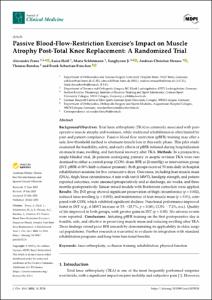
| dc.description.abstract | Background/Objectives: Total knee arthroplasty (TKA) is commonly associated with postoperative muscle atrophy and weakness, while traditional rehabilitation is often limited by pain and patient compliance. Passive blood flow restriction (pBFR) training may offer a safe, low-threshold method to attenuate muscle loss in this early phase. This pilot study examined the feasibility, safety, and early effects of pBFR initiated during hospitalization on muscle mass, swelling, and functional recovery after TKA. Methods: In a prospective, single-blinded trial, 26 patients undergoing primary or aseptic revision TKA were randomized to either a control group (CON: sham BFR at 20 mmHg) or intervention group (INT: pBFR at 80% limb occlusion pressure). Both groups received 50 min daily in-hospital rehabilitation sessions for five consecutive days. Outcomes, including lean muscle mass (DXA), thigh/knee circumference, 6 min walk test (6 MWT), handgrip strength, and patientreported outcomes, were assessed preoperatively and at discharge, six weeks, and three months postoperatively. Linear mixed models with Bonferroni correction were applied. Results: The INT group showed significant preservation of thigh circumference (p = 0.002), reduced knee swelling (p < 0.001), and maintenance of lean muscle mass (p < 0.01), compared with CON, which exhibited significant declines. Functional performance improved faster in INT (e.g., 6 MWT increase at T3: +23.7%, p < 0.001; CON: −7.2%, n.s.). Quality of life improved in both groups, with greater gains in INT (p < 0.05). No adverse events were reported. Conclusions: Initiating pBFR training on the first postoperative day is feasible, safe, and effective in preserving muscle mass and reducing swelling after TKA. These findings extend prior BFR research by demonstrating its applicability in older, surgical populations. Further research is warranted to evaluate its integration with standard rehabilitation programs and long-term functional benefits. | en |
| dc.format.extent | 17 | |
| dc.language.iso | eng | |
| dc.rights | Namensnennung 4.0 International | |
| dc.rights.uri | http://creativecommons.org/licenses/by/4.0/ | |
| dc.subject | knee arthroplasty | |
| dc.subject | occlusion training | |
| dc.subject | rehabilitation | |
| dc.subject | physical function | |
| dc.subject.ddc | 610 Medizin, Gesundheit | |
| dc.title | Passive Blood-Flow-Restriction Exercise's Impact on Muscle Atrophy Post-Total Knee Replacement | |
| dc.title.alternative | A Randomized Trial | |
| dc.type | Wissenschaftlicher Artikel | |
| dc.publisher.name | MDPI | |
| dc.publisher.location | Lausanne | |
| dc.rights.accessRights | openAccess | |
| dcterms.bibliographicCitation.volume | 2025, vol. 14 | |
| dcterms.bibliographicCitation.issue | iss. 15, 5218 | |
| dcterms.bibliographicCitation.pagestart | 1 | |
| dcterms.bibliographicCitation.pageend | 17 | |
| dc.relation.doi | https://doi.org/10.3390/jcm14155218 | |
| dcterms.bibliographicCitation.journaltitle | Journal of clinical medicine | |
| ulbbn.pubtype | Zweitveröffentlichung | |
| dc.version | publishedVersion | |
| ulbbn.sponsorship.oaUnifund | OA-Förderung Universität Bonn |
Files in this item
This item appears in the following Collection(s)
-
Publikationen (8)
The following license files are associated with this item: