

Mesiodistal width correlation between primary and successor mandibular teethimplication for early orthodontic diagnosis

Mesiodistal width correlation between primary and successor mandibular teeth
implication for early orthodontic diagnosis
| dc.contributor.author | Cakir, Aleyna | |
| dc.contributor.author | Both, Annika | |
| dc.contributor.author | Kirschneck, Christian | |
| dc.contributor.author | Daratsianos, Nikolaos | |
| dc.contributor.author | Miranda de Araújo, Cristiano | |
| dc.contributor.author | Corá, Juliane | |
| dc.contributor.author | Calvano Küchler, Erika | |
| dc.contributor.author | Beisel-Memmert, Svenja | |
| dc.contributor.editor | Grassia, Vincenzo | |
| dc.date.accessioned | 2025-12-29T12:03:23Z | |
| dc.date.available | 2025-12-29T12:03:23Z | |
| dc.date.issued | 24.09.2025 | |
| dc.identifier.uri | https://hdl.handle.net/20.500.11811/13790 | |
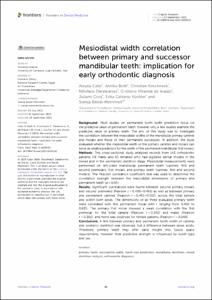
| dc.description.abstract | Background: Most studies on permanent tooth width prediction focus on the predictive value of permanent teeth, however only a few studies examine the predictive value of primary teeth. The aim of this study was to investigate the correlation between the mesiodistal widths of the mandibular primary canines and molars and those of their permanent successors. In addition, the study evaluated whether the mesiodistal width of the primary canines and molars can serve as reliable predictors for the width of the permanent mandibular first molars. Methods: This cross-sectional study analyzed records from 143 orthodontic patients (78 males and 65 females) who had digitized dental models in the mixed and in the permanent dentition stage. Mesiodistal measurements were performed on left-sided mandibular permanent teeth (canines, first and second premolars, first molar), and primary teeth (canines, first and second molars). The Pearson correlation coefficient test was used to determine the correlation strength between the mesiodistal dimensions of primary and permanent teeth (p < 0.05). Results: Significant correlations were found between second primary molars and second premolars (Pearson r = 0.400–0.461) as well as between primary and permanent canines (Pearson r = 0.462–0.512), across the total sample and within both sexes. The dimensions of all three evaluated primary teeth were correlated with first permanent molar with r ranging from 0.402 to 0.625. The primary first molar showed a weak correlation with the first premolar for the total sample (Pearson r = 0.240) and males (Pearson r = 0.302), and none was observed for female patients (Pearson r = 0.048). Conclusions: A link between primary and permanent tooth width of canines and posterior dentition was observed, but a difference between sexes exists. Therefore, primary teeth may offer early insight into future space requirements, however their predictive strength is influenced by tooth type and sex. | en |
| dc.format.extent | 8 | |
| dc.language.iso | eng | |
| dc.rights | Namensnennung 4.0 International | |
| dc.rights.uri | http://creativecommons.org/licenses/by/4.0/ | |
| dc.subject | primary teeth | |
| dc.subject | mesiodistal width | |
| dc.subject | tooth size prediction | |
| dc.subject | mandibular dentition | |
| dc.subject | mixed dentition analysis | |
| dc.subject | orthodontic diagnosis | |
| dc.subject.ddc | 610 Medizin, Gesundheit | |
| dc.title | Mesiodistal width correlation between primary and successor mandibular teeth | |
| dc.title.alternative | implication for early orthodontic diagnosis | |
| dc.type | Wissenschaftlicher Artikel | |
| dc.publisher.name | Frontiers Media | |
| dc.publisher.location | Lausanne | |
| dc.rights.accessRights | openAccess | |
| dcterms.bibliographicCitation.volume | 2025, vol. 6 | |
| dcterms.bibliographicCitation.issue | 1659242 | |
| dcterms.bibliographicCitation.pagestart | 1 | |
| dcterms.bibliographicCitation.pageend | 8 | |
| dc.relation.doi | https://doi.org/10.3389/fdmed.2025.1659242 | |
| dcterms.bibliographicCitation.journaltitle | Frontiers in Dental medicine | |
| ulbbn.pubtype | Zweitveröffentlichung | |
| dc.version | publishedVersion | |
| ulbbn.sponsorship.oaUnifund | OA-Förderung Universität Bonn |
Files in this item
This item appears in the following Collection(s)
-
Publikationen (5)
-
Publikationen (3)
The following license files are associated with this item: