

Simulation-based inference of cell migration dynamics in complex spatial environments

Simulation-based inference of cell migration dynamics in complex spatial environments
| dc.contributor.author | Arruda, Jonas | |
| dc.contributor.author | Alamoudi, Emad | |
| dc.contributor.author | Mueller, Robert | |
| dc.contributor.author | Vaisband, Marc | |
| dc.contributor.author | Molkenbur, Ronja | |
| dc.contributor.author | Merrin, Jack | |
| dc.contributor.author | Kiermaier, Eva | |
| dc.contributor.author | Hasenauer, Jan | |
| dc.date.accessioned | 2026-05-12T12:15:39Z | |
| dc.date.available | 2026-05-12T12:15:39Z | |
| dc.date.issued | 29.01.2026 | |
| dc.identifier.uri | https://hdl.handle.net/20.500.11811/14141 | |
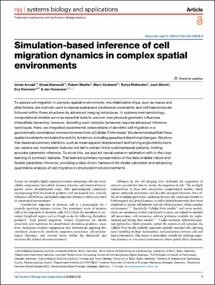
| dc.description.abstract | To assess cell migration in complex spatial environments, microfabricated chips, such as mazes and pillar forests, are routinely used to impose spatial and mechanical constraints, and cell trajectories are followed within these structures by advanced imaging techniques. In systems mechanobiology, computational models serve as essential tools to uncover how physical geometry influences intracellular dynamics; however, decoding such complex behaviors requires advanced inference techniques. Here, we integrated experimental observations of dendritic cell migration in a geometrically constrained microenvironment into a Cellular Potts model. We demonstrated that these spatial constraints modulate the motility dynamics, including speed and directional changes. We show that classical summary statistics, such as mean squared displacement and turning angle distributions, can resolve key mechanistic features but fail to extract richer spatiotemporal patterns, limiting accurate parameter inference. To solve this, we applied neural posterior estimation with in-the-loop learning of summary features. This learned summary representation of the data enables robust and flexible parameter inference, providing a data-driven framework for model calibration and advancing quantitative analysis of cell migration in structured microenvironments. | en |
| dc.format.extent | 15 | |
| dc.language.iso | eng | |
| dc.rights | Namensnennung 4.0 International | |
| dc.rights.uri | http://creativecommons.org/licenses/by/4.0/ | |
| dc.subject.ddc | 500 Naturwissenschaften | |
| dc.subject.ddc | 570 Biowissenschaften, Biologie | |
| dc.title | Simulation-based inference of cell migration dynamics in complex spatial environments | |
| dc.type | Wissenschaftlicher Artikel | |
| dc.publisher.name | Springer Nature | |
| dc.publisher.location | Berlin | |
| dc.rights.accessRights | openAccess | |
| dc.relation.pmid | 41611727 | |
| dcterms.bibliographicCitation.volume | 2026, 12 | |
| dcterms.bibliographicCitation.issue | art. 20 | |
| dcterms.bibliographicCitation.pagestart | 1 | |
| dcterms.bibliographicCitation.pageend | 15 | |
| dc.relation.doi | https://doi.org/10.1038/s41540-026-00648-9 | |
| dcterms.bibliographicCitation.journaltitle | npj Systems biology and applications | |
| ulbbn.pubtype | Zweitveröffentlichung | |
| dc.version | publishedVersion |
Files in this item
This item appears in the following Collection(s)
-
Publikationen (6)
The following license files are associated with this item: