

Beyond insecticide treated bed nets coverage to heterogeneous human behaviors and spatial realities

Beyond insecticide treated bed nets coverage to heterogeneous human behaviors and spatial realities
| dc.contributor.author | Savi, Merveille Koissi | |
| dc.contributor.author | Childs, Lauren M. | |
| dc.contributor.author | Borgemeister, Christian | |
| dc.date.accessioned | 2025-11-05T17:11:49Z | |
| dc.date.available | 2025-11-05T17:11:49Z | |
| dc.date.issued | 16.05.2025 | |
| dc.identifier.uri | https://hdl.handle.net/20.500.11811/13630 | |
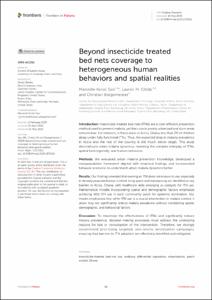
| dc.description.abstract | Introduction: Insecticide-treated bed nets (ITNs) are a cost-efficient prevention method used to prevent malaria, yet their use in poorly urbanized and slum areas remains low. For instance, in these areas in Accra, Ghana, less than 2% of children sleep under fully functional ITNs. Thus, the expected drop in malaria prevalence in Accra and the rest of the country is still much below target. This study deconstructs urban malaria dynamics, revealing the complex interplay of ITNs, spatial heterogeneity, and human behaviors. Methods: We evaluated urban malaria prevention knowledge, developed a metapopulation framework aligned with empirical findings, and incorporated behavior scenarios to understand urban malaria dynamics better. Results: Our findings revealed that owning an ITN does not ensure its use, especially in densely populated areas. Limited living space and repurposing are identified as key barriers in Accra, Ghana, with healthcare visits emerging as catalysts for ITN use. Mathematical models incorporating spatial and demographic factors emphasize achieving 60% ITN use in each community patch for epidemic elimination. Our model emphasizes that while ITN use is a crucial intervention in malaria control, it alone may not significantly reduce malaria prevalence without considering spatial, demographic, and behavioral factors. Discussion: To maximize the effectiveness of ITNs and significantly reduce malaria prevalence, decision-making processes must address the underlying reasons for late or nonadoption of the intervention. Therefore, we strongly recommend prioritizing targeted, one-onone sensitization campaigns, ensuring that barriers to ITN adoption are effectively identified and mitigated. | en |
| dc.format.extent | 13 | |
| dc.language.iso | eng | |
| dc.rights | Namensnennung 4.0 International | |
| dc.rights.uri | http://creativecommons.org/licenses/by/4.0/ | |
| dc.subject | insecticide-treated bed-net use | |
| dc.subject | ordinary differential equations | |
| dc.subject | urbanization | |
| dc.subject | patch model | |
| dc.subject | Ghana | |
| dc.subject.ddc | 610 Medizin, Gesundheit | |
| dc.title | Beyond insecticide treated bed nets coverage to heterogeneous human behaviors and spatial realities | |
| dc.type | Wissenschaftlicher Artikel | |
| dc.publisher.name | Frontiers Media | |
| dc.publisher.location | Lausanne | |
| dc.rights.accessRights | openAccess | |
| dcterms.bibliographicCitation.volume | 2025, vol. 3 | |
| dcterms.bibliographicCitation.issue | 1571912 | |
| dcterms.bibliographicCitation.pagestart | 1 | |
| dcterms.bibliographicCitation.pageend | 13 | |
| dc.relation.doi | https://doi.org/10.3389/fmala.2025.1571912 | |
| dcterms.bibliographicCitation.journaltitle | Frontiers in Malaria | |
| ulbbn.pubtype | Zweitveröffentlichung | |
| dc.version | publishedVersion | |
| ulbbn.sponsorship.oaUnifund | OA-Förderung Universität Bonn |
Files in this item
This item appears in the following Collection(s)
-
Publikationen (33)
The following license files are associated with this item: