

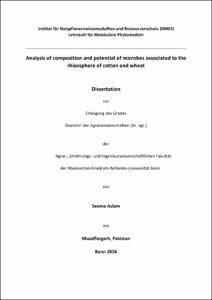
Analysis of composition and potential of microbes associated to the rhizosphere of cotton and wheat

Analysis of composition and potential of microbes associated to the rhizosphere of cotton and wheat
| dc.contributor.advisor | Grundler, Florian M. W. | |
| dc.contributor.author | Aslam, Seema | |
| dc.date.accessioned | 2026-01-12T11:44:38Z | |
| dc.date.available | 2026-01-12T11:44:38Z | |
| dc.date.issued | 12.01.2026 | |
| dc.identifier.uri | https://hdl.handle.net/20.500.11811/13814 | |
| dc.description.abstract | Pathogenic fungi and plant-parasitic nematodes threaten the health of crops and thus impair agricultural production. Fungi cause a wide variety of diseases by destroying plant tissue in different ways, disrupting the plant's metabolism, and triggering various defense reactions. Nematodes very often infest the roots of agricultural crops, parasitize or destroy cells, and cause anatomical, morphological, and physiological disorders, resulting in a significant loss of performance and resilience to abiotic stress factors. Since synthetic pesticides often have negative effects on the environment and possibly also on humans, there is a growing need for sustainable approaches to control these pathogens. Plant Growth-Promoting Rhizobacteria (PGPR) offer a promising solution for biological control. PGPR are beneficial bacteria that colonize plant roots and enhance plant growth through various mechanisms. They can suppress fungal and nematode pathogens by producing antimicrobial compounds, triggering systemic resistance in plants, and competing for nutrients and space. Using PGPR as biocontrol agents provides an environmentally friendly and sustainable method for the management of plant diseases, reduces reliance on synthetic chemicals, and promotes healthier ecosystems. This study aims to analyze the PGPR present in the rhizosphere of cotton and wheat under continuous cotton-wheat rotation in Pakistan. It also investigates the biological control potential of these rhizobacteria against the fungus Fusarium oxysporum f. sp. vasinfectum (FOV) in cotton and against Heterodera schachtii in Arabidopsis thaliana, as well as their effect on plant growth. Chapter 2 presents a metagenomic-based investigation of the microbial community, including bacteria and fungi (including all culturable and non-culturable), in the rhizosphere of cotton from four different agroecological sites. The study revealed that the abundance of bacterial and fungal communities varied across the different agroecological sites, even with the same crop and rotation pattern. These differences suggest that specific bacteria exhibit adaptations to their environment and that various other factors beyond the crop itself shape the microbial community. Chapter 3 presents the investigation of antifungal activity against FOV, biochemical characterization, and genetic diversity of 136 culturable rhizobacteria from five different cotton fields and five different wheat fields. The dendrogram constructed from (GTG)5 and REP-PCR fingerprint profiles indicated greater diversity. Molecular markers used for genetic fingerprinting effectively differentiated the cotton rhizosphere isolates from those obtained from the wheat rhizosphere, indicating a distinct resident bacterial community despite the cotton-wheat rotation. Chapter 4 presents an investigation of Bacillus species isolated from cotton. The eight characterized Bacillus isolates all showed biocontrol potential against FOV with different mechanisms of action. Chapter 5 presents an investigation of the antagonistic effect of Bacillus spp. against H. schachtii in A. thaliana. Seven Bacillus isolates showed anti-nematode activity both in vitro and in vivo, and also reduced the size of females. This research revealed that a number of Bacillus spp. among 136 isolated and divers rhizobacteria effectively suppressed FOV and H. schachtii by different antagonistic mechanisms. These Bacillus spp. can be a valuable means as part of an integrated fungal and nematode control strategy. Moreover, this study is the first to report the antagonistic activity of Bacillus stercoris against a plant-parasitic nematode. | en |
| dc.language.iso | eng | |
| dc.rights | In Copyright | |
| dc.rights.uri | http://rightsstatements.org/vocab/InC/1.0/ | |
| dc.subject | Biocontrol | |
| dc.subject | PGPR | |
| dc.subject | Bacillus spp. | |
| dc.subject | Cotton wheat rotation | |
| dc.subject | Heterodera schachtii | |
| dc.subject.ddc | 630 Landwirtschaft, Veterinärmedizin | |
| dc.title | Analysis of composition and potential of microbes associated to the rhizosphere of cotton and wheat | |
| dc.type | Dissertation oder Habilitation | |
| dc.publisher.name | Universitäts- und Landesbibliothek Bonn | |
| dc.publisher.location | Bonn | |
| dc.rights.accessRights | openAccess | |
| dc.identifier.urn | https://nbn-resolving.org/urn:nbn:de:hbz:5-87181 | |
| dc.relation.doi | https://doi.org/10.1007/s42977-025-00269-z | |
| dc.relation.doi | https://doi.org/10.3389/fmicb.2025.1580937 | |
| ulbbn.pubtype | Erstveröffentlichung | |
| ulbbnediss.affiliation.name | Rheinische Friedrich-Wilhelms-Universität Bonn | |
| ulbbnediss.affiliation.location | Bonn | |
| ulbbnediss.thesis.level | Dissertation | |
| ulbbnediss.dissID | 8718 | |
| ulbbnediss.date.accepted | 26.09.2025 | |
| ulbbnediss.institute | Agrar-, Ernährungs- und Ingenieurwissenschaftliche Fakultät : Institut für Nutzpflanzenwissenschaften und Ressourcenschutz (INRES) | |
| ulbbnediss.fakultaet | Agrar-, Ernährungs- und Ingenieurwissenschaftliche Fakultät | |
| dc.contributor.coReferee | Knief, Claudia | |
| ulbbnediss.contributor.orcid | https://orcid.org/0009-0003-5820-1526 |
Files in this item
This item appears in the following Collection(s)
-
E-Dissertationen (1188)
The following license files are associated with this item: