

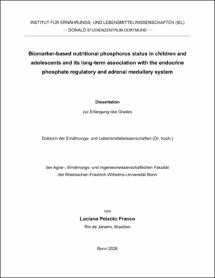
Biomarker-based nutritional phosphorus status in children and adolescents and its long-term association with the endocrine phosphate regulatory and adrenal medullary system
Biomarker-based nutritional phosphorus status in children and adolescents and its long-term association with the endocrine phosphate regulatory and adrenal medullary system
| dc.contributor.advisor | Remer, Thomas | |
| dc.contributor.author | Peixoto Franco, Luciana | |
| dc.date.accessioned | 2026-01-27T12:54:39Z | |
| dc.date.issued | 27.01.2026 | |
| dc.identifier.uri | https://hdl.handle.net/20.500.11811/13853 | |
| dc.description.abstract | This thesis investigates biomarker-based the long-term physiological implications of higher phosphorus intake during childhood and adolescence, with a focus on how a habitually phosphorus-rich nutrition during growth shapes the phosphate metabolism-related endocrine and the sympathetic nervous system. Using longitudinal data from the DONALD (DOrtmund Nutritional and Anthropometric Longitudinally Designed) Study, the research integrates biomarker-based assessments of nutrient intake with 24h urine and blood measurements in young adulthood to examine in three studies implications and consequences of long-term phosphorus ingestion relevantly exceeding dietary recommendations. Study I examined trends in phosphorus intake (P-In) among German children and adolescents over a 30-year period (1985–2015), using 24-hour urinary phosphate excretion (PO4-Ex) as a biomarker. Despite considerable changes in the food environment, PO4-Ex remained stable over time. However, intake levels consistently exceeded recommended dietary allowances (RDAs), pointing to chronic overexposure in around half of the participants examined. PO4-Ex was significantly associated with protein and sodium intake, net acid excretion, and inversely with fruit and vegetable intake all biomarker-based assessed, indicating that phosphate metabolism is shaped not only by absolute intake, but also by overall dietary quality and acid–base balance. Study II extended these findings by linking habitual P-In and dietary acid load during growth with endocrine markers of phosphate regulation—namely fibroblast growth factor 23 (FGF23) and α-klotho—in young adulthood. A positive association was observed between early P-In and circulating FGF23 levels, indicating that high phosphorus exposure during critical developmental periods may alter long-term endocrine regulation. This suggests that dietary phosphorus exerts a long-lasting regulatory influence on the endocrine pathways governing phosphate metabolism with adversly altering the constellation of FGF23 and α-klotho in a way that is usually seen along with kidney decline. In Study III the link between urinary catecholamine excretion in young adulthood and preceding P-In in children and adolescents had been investigated. The results revealed a significant, sex-specific association between early phosphorus intake and increased excretion of epinephrine and norepinephrine in females—suggesting that phosphorus may play a role in modulating sympathetic nervous system activity in the long-term. These findings introduce the possibility that habitual phosphate exposure during growth could influence neuroendocrine stress responses later in life, potentially through adrenally involved phosphate-sensitive pathways. Overall, the studies provide support for the concept that chronic dietary phosphorus excess, particularly from various probably well available sources, acts through multiple regulatory axes—including endocrine, renal, and sympathoadrenal pathways—to potentially unfavorable influence long-term metabolic and physiological health. | en |
| dc.description.abstract | Die vorliegende Arbeit untersucht biomarkerbasiert mögliche physiologische Langzeitauswirkungen einer hohen Phosphoraufnahme (PA) in Kindheit und Adoleszenz. Ein besonderer Fokus liegt dabei zum einen auf direkt mit dem Phosphatstoffwechsel interagierenden und zum anderen auf eng mit dem sympathischen Nervensystem assoziierten Hormonsystemen. Für die Untersuchungen wurden ausschließlich Daten der Dortmunder DONALD Langzeitstudie genutzt. Dabei wurde die PA und die Zufuhr weiterer relevanter Nährstoffe biomarkerbasiert in 24-Stunden Urinen ermittelt und langfristige Konsequenzen insbesondere einer über den Nährstoffempfehlungen liegenden PA durch Messungen von Blutparametern im Erwachsenenalter überprüft. In einer ersten Studie wurde der Trend der PA von Kindern und Jugendlichen über einen 30jährigen Zeitraum (1985-2015) durch Messung des Biomarkers Phosphatausscheidung in 24h-Urinen (PO4-24h) analysiert. Dabei fand sich über den gesamten Beobachtungszeitraum eine ausgeprägt stabile PA, die in allen Altersgruppen bei etwa der Hälfte der Jungen und Mädchen oberhalb der Zufuhr-empfehlungen lag. Die PA war signifikant positiv mit der Protein- und Salzzufuhr und der Nettosäureausscheidung sowie invers mit dem ebenfalls biomarkerbasiert geschätzten Obst- und Gemüseverzehr assoziiert, was den engen Zusammenhang der Höhe der PA mit Ernährungsqualität und Säure-Basen-Haushalt (SBH) bestätigt. Studie 2 verknüpft die Befunde zur langfristigen PA und dem ernährungsabhängigen SBH im Wachstumsalter mit der Untersuchung von endokrinen Markern der Phosphat-Regulation im Erwachsenenalter – insbesondere dem zirkulierenden Fibroblast Growth Factor 23 (FGF23) und α-Klotho. Vor allem für FGF23 zeigte sich ein Zusammenhang mit der habituellen PA, was nahelegt, dass eine langfristig hohe nutritive Phosphor-Exposition in Kindheit und Adoleszenz die endokrine Langzeitregulation des Phosphat-Stoffwechsels nachteilig moduliert und dabei das Ratio von FGF23 zu α-Klotho in eine Richtung beeinflusst, wie sie üblicherweise bei einem Rückgang der Nierenfunktion beobachtet wird. Studie 3 untersuchte den Zusammenhang zwischen der Exkretion verschiedener Catecholaminmetabolite im Erwachsenenalter und der vorausgegangenen PA zwischen dem 3. und dem 17 Lebensjahr. Es fand sich eine geschlechtsspezifische Assoziation zwischen hoher PA in Kindheit und Adoleszenz und erhöhter Ausscheidung von Adrenalin und Noradrenalin im 24h-Urin von Frauen, was eine Langzeitbeeinflussung der Aktivität des sympathischen Nervensystems durch eine hohe PA nahelegt. Damit ergeben sich robuste Hinweise, dass eine regelmäßig über den Zufuhrempfehlungen liegende Phosphorzufuhr im Wachstumsalter die neuroendokrinen Stressantworten junger Frauen verstärken könnten. Insgesamt stützen die Untersuchungen dieser Arbeit das Konzept, dass die regelmäßig beobachtbare habituell hohe Phosphor-Aufnahme von Kindern und Jugendlichen über unterschiedliche regulatorische Mechanismen – einschließlich endokriner, renaler und sympathoadrenaler Interaktionen – die Stoffwechselgesundheit im Erwachsenenalter nachteilig beeinflussen kann. | de |
| dc.language.iso | eng | |
| dc.rights | In Copyright | |
| dc.rights.uri | http://rightsstatements.org/vocab/InC/1.0/ | |
| dc.subject | Phosphorus intake | |
| dc.subject | Phosphate excretion | |
| dc.subject | Urinary biomarkers | |
| dc.subject | habitual dietary acid load | |
| dc.subject | fibroblast growth factor 23 | |
| dc.subject | alpha-klotho | |
| dc.subject | catecholamines | |
| dc.subject.ddc | 610 Medizin, Gesundheit | |
| dc.title | Biomarker-based nutritional phosphorus status in children and adolescents and its long-term association with the endocrine phosphate regulatory and adrenal medullary system | |
| dc.type | Dissertation oder Habilitation | |
| dc.identifier.doi | https://doi.org/10.48565/bonndoc-765 | |
| dc.publisher.name | Universitäts- und Landesbibliothek Bonn | |
| dc.publisher.location | Bonn | |
| dc.rights.accessRights | embargoedAccess | |
| dc.date.embargoEndDate | 01.09.2026 | |
| dc.identifier.urn | https://nbn-resolving.org/urn:nbn:de:hbz:5-87528 | |
| dc.relation.doi | https://doi.org/10.1016/j.jand.2024.02.008 | |
| dc.relation.doi | https://doi.org/10.1038/s41598-024-79636-0 | |
| dc.relation.doi | https://doi.org/10.1007/s42000-025-00735-2 | |
| dc.relation.doi | https://doi.org/10.3390/ijms25031408 | |
| dc.relation.doi | https://doi.org/10.1053/j.jrn.2024.12.002 | |
| ulbbn.pubtype | Erstveröffentlichung | |
| ulbbnediss.affiliation.name | Rheinische Friedrich-Wilhelms-Universität Bonn | |
| ulbbnediss.affiliation.location | Bonn | |
| ulbbnediss.thesis.level | Dissertation | |
| ulbbnediss.dissID | 8752 | |
| ulbbnediss.date.accepted | 24.11.2025 | |
| ulbbnediss.institute | Agrar-, Ernährungs- und Ingenieurwissenschaftliche Fakultät : Institut für Ernährungs- und Lebensmittelwissenschaften (IEL) | |
| ulbbnediss.fakultaet | Agrar-, Ernährungs- und Ingenieurwissenschaftliche Fakultät | |
| dc.contributor.coReferee | Wudy, Stefan |
Dateien zu dieser Ressource
Dieses Dokument ist zur Zeit gesperrt.
Das Dokument erscheint in:
-
E-Dissertationen (1182)
Die folgenden Nutzungsbestimmungen sind mit dieser Ressource verbunden: