

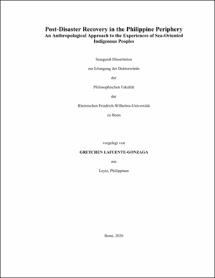
Post-Disaster Recovery in the Philippine PeripheryAn Anthropological Approach to the Experiences of Sea-Oriented Indigenous Peoples

Post-Disaster Recovery in the Philippine Periphery
An Anthropological Approach to the Experiences of Sea-Oriented Indigenous Peoples
| dc.contributor.advisor | Antweiler, Christoph | |
| dc.contributor.author | Lafuente-Gonzaga, Gretchen | |
| dc.date.accessioned | 2026-03-04T13:45:27Z | |
| dc.date.available | 2026-03-04T13:45:27Z | |
| dc.date.issued | 04.03.2026 | |
| dc.identifier.uri | https://hdl.handle.net/20.500.11811/13946 | |
| dc.description.abstract | Vulnerable populations face the highest risks during disasters, not only because of exposure to hazards but also due to marginalization, which heightens their vulnerability. The impacts of disasters intensify when high-risk groups, particularly displaced Indigenous peoples, are not adequately included in disaster risk management efforts. The Sama Badjao are sea-oriented Indigenous peoples residing in the coastal areas of the Philippines. Their precarious circumstances, such as tightening border controls, ongoing armed conflicts, declining fish stocks, and movement restrictions, have compelled them to adopt a semi-sedentary lifestyle while maintaining their homes close to the sea. The experiences of the Sama Badjao challenge conventional notions of vulnerability and resilience in disaster contexts. This study investigates their post-disaster experiences following Super Typhoon Rai in 2021. To frame their narratives, I combined and adapted the concepts of othering and intersectionality theory within a historical context influenced by structural discrimination and exclusion based on gender, indigeneity, and religion. I gathered data through a household census, participant observation, semi-structured and unstructured interviews, and focus group discussions, culminating in 10 months of fieldwork (2021-2022) in the coastal area of Bato, Leyte, Philippines. Findings revealed that the Sama Badjao were well-prepared for the impact of Super Typhoon Rai. They utilized their Indigenous knowledge and defined gender roles that complemented each family member's responsibilities before, during, and after a disaster, along with mutual kinship support. Nonetheless, Rai's unprecedented strength and misleading comparisons to Super Typhoon Haiyan in 2013 fostered complacency among the men, as Haiyan's landfall was slightly farther from their community. This led to delayed evacuation efforts among some households. A month later, the Sama Badjao community faced exclusion from state relief and recovery programs, including shelter reconstruction materials. They were initially denied monetary aid due to ongoing structural discrimination, which involved misrepresentations of their cultural identity and traditions, as well as exclusionary rules and policies targeting sea-based Indigenous communities. The traditional livelihood practice of Magosaha was misinterpreted from a Eurocentric and modernist perspective. Meanwhile, the lack of culturally appropriate aid reinforced their marginalized status. Intersection of indigeneity, gender, and religious identities shaped unequal access to resources for immediate recovery, exacerbating their vulnerability and placing women, the elderly, single parents, and children left behind in the community in a more disadvantaged situation, along with stigmas and stereotypes as 'beggars,' 'dirty,' and 'outsiders.' At the same time, the study highlights how the Sama Badjao people resist dominant narratives, counteract imposed identities, and challenge the public representation of 'Badjao' on the periphery. They engaged in nonconfrontational but strategic acts of resistance, such as rebuilding stilt houses to reclaim coastal space, women assuming caretaking and leadership roles, and continuing the practice of Magosaha. This research calls for inclusive and culturally informed disaster governance that recognizes Indigenous knowledge, addresses intersectional vulnerabilities, and ensures the genuine participation of marginalized communities in recovery processes. | en |
| dc.language.iso | eng | |
| dc.rights | In Copyright | |
| dc.rights.uri | http://rightsstatements.org/vocab/InC/1.0/ | |
| dc.subject | Sama Dilaut | |
| dc.subject | Badjao | |
| dc.subject | Bajau | |
| dc.subject | Othering | |
| dc.subject | Intersectionality | |
| dc.subject | Strucrtural marginalization | |
| dc.subject | Post-disaster rehabilitation | |
| dc.subject.ddc | 300 Sozialwissenschaften, Soziologie, Anthropologie | |
| dc.title | Post-Disaster Recovery in the Philippine Periphery | |
| dc.title.alternative | An Anthropological Approach to the Experiences of Sea-Oriented Indigenous Peoples | |
| dc.type | Dissertation oder Habilitation | |
| dc.publisher.name | Universitäts- und Landesbibliothek Bonn | |
| dc.publisher.location | Bonn | |
| dc.rights.accessRights | openAccess | |
| dc.identifier.urn | https://nbn-resolving.org/urn:nbn:de:hbz:5-88356 | |
| ulbbn.pubtype | Erstveröffentlichung | |
| ulbbn.birthname | Lafuente | |
| ulbbnediss.affiliation.name | Rheinische Friedrich-Wilhelms-Universität Bonn | |
| ulbbnediss.affiliation.location | Bonn | |
| ulbbnediss.thesis.level | Dissertation | |
| ulbbnediss.dissID | 8835 | |
| ulbbnediss.date.accepted | 03.02.2026 | |
| ulbbnediss.institute | Zentrale wissenschaftliche Einrichtungen : Zentrum für Entwicklungsforschung (ZEF) | |
| ulbbnediss.fakultaet | Philosophische Fakultät | |
| dc.contributor.coReferee | Großmann, Kristina | |
| ulbbnediss.contributor.orcid | https://orcid.org/0000-0001-5953-6836 |
Files in this item
This item appears in the following Collection(s)
-
E-Dissertationen (736)
The following license files are associated with this item: