

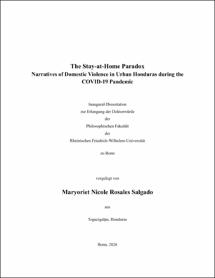
The Stay-at-Home ParadoxNarratives of Domestic Violence in Urban Honduras during the COVID-19 Pandemic

The Stay-at-Home Paradox
Narratives of Domestic Violence in Urban Honduras during the COVID-19 Pandemic
| dc.contributor.advisor | Youkhana, Eva | |
| dc.contributor.author | Rosales Salgado, Maryoriet Nicole | |
| dc.date.accessioned | 2026-03-04T15:05:16Z | |
| dc.date.available | 2026-03-04T15:05:16Z | |
| dc.date.issued | 04.03.2026 | |
| dc.identifier.uri | https://hdl.handle.net/20.500.11811/13947 | |
| dc.description.abstract | This dissertation examines how the risk of domestic violence for women living in urban and peri-urban areas of the Central District of Honduras was intensified by the pandemic. Honduras has long experienced high levels of gender-based violence, which are rooted in historical patterns of patriarchal domination, social inequality and colonial legacies. Restrictive measures introduced during the early months of the pandemic, such as lockdowns, mobility limitations and economic disruption, exacerbated existing vulnerabilities for women, particularly those living in impoverished urban areas. Despite the growing focus on violence against women in Honduras, there has been limited research documenting women's experiences during times of crisis. This study addresses this gap by examining how Honduran households became unsafe spaces for women during the first five months of the pandemic. Drawing on 67 in-depth phone and video interviews conducted between March and July 2020, the research focuses on women residents of the peri-urban settlements of La Era and Los Pinos, survivors of domestic violence connected to feminist organisations, and frontline experts working in violence prevention. Using a flexible narrative methodology, the study centres on women's personal accounts of daily life during lockdown, capturing experiences related to economic insecurity, food and water scarcity, intensified caregiving responsibilities, and limited access to protection and support services. Analysis is guided by a unified theoretical framework combining intersectional and decolonial feminist perspectives with Sylvia Walby's theory of gender regimes. This enables exploration of how economic, political and socio-cultural structures interact to shape women's exposure to violence. This dissertation makes an empirical and conceptual contribution to the scholarship on gender-based violence in Honduras by foregrounding women's narratives and situating domestic violence within the context of broader structural systems of patriarchal power. It demonstrates how intersecting inequalities and institutional shortcomings during the pandemic heightened women's vulnerability, while also highlighting their strategies of resistance and survival. By documenting these experiences, the research provides valuable insights for feminist scholarship, public health policy and violence prevention initiatives in crisis contexts. | en |
| dc.language.iso | eng | |
| dc.rights | In Copyright | |
| dc.rights.uri | http://rightsstatements.org/vocab/InC/1.0/ | |
| dc.subject | Häusliche Gewalt | |
| dc.subject | geschlechtsspezifische Gewalt | |
| dc.subject | Honduras | |
| dc.subject | Feminismus im globalen Süden | |
| dc.subject | Dekolonialisierung | |
| dc.subject | Domestic violence | |
| dc.subject | gender-based violence | |
| dc.subject | Honduras | |
| dc.subject | feminism in the Global South | |
| dc.subject | decolonisation | |
| dc.subject.ddc | 300 Sozialwissenschaften, Soziologie, Anthropologie | |
| dc.title | The Stay-at-Home Paradox | |
| dc.title.alternative | Narratives of Domestic Violence in Urban Honduras during the COVID-19 Pandemic | |
| dc.type | Dissertation oder Habilitation | |
| dc.publisher.name | Universitäts- und Landesbibliothek Bonn | |
| dc.publisher.location | Bonn | |
| dc.rights.accessRights | openAccess | |
| dc.identifier.urn | https://nbn-resolving.org/urn:nbn:de:hbz:5-88452 | |
| ulbbn.pubtype | Erstveröffentlichung | |
| ulbbnediss.affiliation.name | Rheinische Friedrich-Wilhelms-Universität Bonn | |
| ulbbnediss.affiliation.location | Bonn | |
| ulbbnediss.thesis.level | Dissertation | |
| ulbbnediss.dissID | 8845 | |
| ulbbnediss.date.accepted | 06.11.2025 | |
| ulbbnediss.institute | Zentrale wissenschaftliche Einrichtungen : Zentrum für Entwicklungsforschung (ZEF) | |
| ulbbnediss.fakultaet | Philosophische Fakultät | |
| dc.contributor.coReferee | Grube, Nikolai |
Files in this item
This item appears in the following Collection(s)
-
E-Dissertationen (737)
The following license files are associated with this item: