
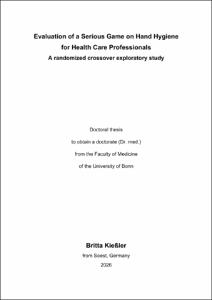
Evaluation of a Serious Game on Hand Hygiene for Health Care ProfessionalsA randomized crossover exploratory study

Evaluation of a Serious Game on Hand Hygiene for Health Care Professionals
A randomized crossover exploratory study
 Dokument öffnen (6.8MB)
Art der Hochschulschrift
DissertationPrüfungsdatum
03.03.2026Datum der Veröffentlichung
24.03.2026Erstgutachter
Jonas, StephanZweitgutachter
Weigl, MatthiasMetadaten
Zur Langanzeige
Zitierbare Links 
Inhalt
Background
Although healthcare-workers' hands are one of the major sources of healthcare associated infections (HCAIs), compliance with hand hygiene remains low. This leads to millions of preventable infections each year worldwide. Major reasons for non-compliance are a lack of knowledge regarding hand hygiene guidelines among staff as well as missing motivation.
Objectives
The objective of our study was to evaluate a mobile application which aims to improve its users' hand rubbing technique of hand hygiene based on World Health Organization's (WHO) recommendations. We also evaluated the application's influence on the users' motivation to perform hand hygiene.
Methods
A mobile application based randomized, controlled, cross-over study was carried out to measure the effect of a 2-weeks training of the WHO hand rubbing technique. We used a pre- (at start t0) and post-questionnaire (at cross-over t1 and end t2) to evaluate and compare the study participants' knowledge about and attitude towards hand hygiene. In the test group, participants were asked to train the hand rubbing technique with the use of gesture control armbands as well as tutorial videos during the first two weeks. In the control group, participants were asked to train by tutorial videos only during that time. During the following two weeks, the instructions were vice versa.
Results
Knowledge concerning correct hand disinfection according to the WHO standard improved through training with gesture control armbands but also through watching tutorial videos. After the test group stopped using the gesture control armbands and were asked to train by watching tutorial videos only, knowledge started to decrease. Whereas in the control group, improvement could be achieved during the first two weeks when only watching tutorial videos, but the group showed further improvement during the last two weeks when being able to use gesture control armbands. Regarding the participants' attitude towards hand hygiene, the use of the application did not cause any changes.
Conclusions
Our results indicate that a mobile application could be an appropriate tool to provide easy and time efficient training of hand hygiene technique knowledge. The use of immediate feedback through wearables could not achieve better results than the use of video-training only.
Although healthcare-workers' hands are one of the major sources of healthcare associated infections (HCAIs), compliance with hand hygiene remains low. This leads to millions of preventable infections each year worldwide. Major reasons for non-compliance are a lack of knowledge regarding hand hygiene guidelines among staff as well as missing motivation.
Objectives
The objective of our study was to evaluate a mobile application which aims to improve its users' hand rubbing technique of hand hygiene based on World Health Organization's (WHO) recommendations. We also evaluated the application's influence on the users' motivation to perform hand hygiene.
Methods
A mobile application based randomized, controlled, cross-over study was carried out to measure the effect of a 2-weeks training of the WHO hand rubbing technique. We used a pre- (at start t0) and post-questionnaire (at cross-over t1 and end t2) to evaluate and compare the study participants' knowledge about and attitude towards hand hygiene. In the test group, participants were asked to train the hand rubbing technique with the use of gesture control armbands as well as tutorial videos during the first two weeks. In the control group, participants were asked to train by tutorial videos only during that time. During the following two weeks, the instructions were vice versa.
Results
Knowledge concerning correct hand disinfection according to the WHO standard improved through training with gesture control armbands but also through watching tutorial videos. After the test group stopped using the gesture control armbands and were asked to train by watching tutorial videos only, knowledge started to decrease. Whereas in the control group, improvement could be achieved during the first two weeks when only watching tutorial videos, but the group showed further improvement during the last two weeks when being able to use gesture control armbands. Regarding the participants' attitude towards hand hygiene, the use of the application did not cause any changes.
Conclusions
Our results indicate that a mobile application could be an appropriate tool to provide easy and time efficient training of hand hygiene technique knowledge. The use of immediate feedback through wearables could not achieve better results than the use of video-training only.
Klassifikation (DDC)
004 Informatik 610 Medizin, GesundheitKießler, Britta: Evaluation of a Serious Game on Hand Hygiene for Health Care Professionals : A randomized crossover exploratory study. - Bonn, 2026. - Dissertation, Rheinische Friedrich-Wilhelms-Universität Bonn.
Online-Ausgabe in bonndoc: https://nbn-resolving.org/urn:nbn:de:hbz:5-88914
Online-Ausgabe in bonndoc: https://nbn-resolving.org/urn:nbn:de:hbz:5-88914
@phdthesis{handle:20.500.11811/14002,
urn: https://nbn-resolving.org/urn:nbn:de:hbz:5-88914,
author = {{Britta Kießler}},
title = {Evaluation of a Serious Game on Hand Hygiene for Health Care Professionals : A randomized crossover exploratory study},
school = {Rheinische Friedrich-Wilhelms-Universität Bonn},
year = 2026,
month = mar,
note = {Background
Although healthcare-workers' hands are one of the major sources of healthcare associated infections (HCAIs), compliance with hand hygiene remains low. This leads to millions of preventable infections each year worldwide. Major reasons for non-compliance are a lack of knowledge regarding hand hygiene guidelines among staff as well as missing motivation.
Objectives
The objective of our study was to evaluate a mobile application which aims to improve its users' hand rubbing technique of hand hygiene based on World Health Organization's (WHO) recommendations. We also evaluated the application's influence on the users' motivation to perform hand hygiene.
Methods
A mobile application based randomized, controlled, cross-over study was carried out to measure the effect of a 2-weeks training of the WHO hand rubbing technique. We used a pre- (at start t0) and post-questionnaire (at cross-over t1 and end t2) to evaluate and compare the study participants' knowledge about and attitude towards hand hygiene. In the test group, participants were asked to train the hand rubbing technique with the use of gesture control armbands as well as tutorial videos during the first two weeks. In the control group, participants were asked to train by tutorial videos only during that time. During the following two weeks, the instructions were vice versa.
Results
Knowledge concerning correct hand disinfection according to the WHO standard improved through training with gesture control armbands but also through watching tutorial videos. After the test group stopped using the gesture control armbands and were asked to train by watching tutorial videos only, knowledge started to decrease. Whereas in the control group, improvement could be achieved during the first two weeks when only watching tutorial videos, but the group showed further improvement during the last two weeks when being able to use gesture control armbands. Regarding the participants' attitude towards hand hygiene, the use of the application did not cause any changes.
Conclusions
Our results indicate that a mobile application could be an appropriate tool to provide easy and time efficient training of hand hygiene technique knowledge. The use of immediate feedback through wearables could not achieve better results than the use of video-training only.},
url = {https://hdl.handle.net/20.500.11811/14002}
}
urn: https://nbn-resolving.org/urn:nbn:de:hbz:5-88914,
author = {{Britta Kießler}},
title = {Evaluation of a Serious Game on Hand Hygiene for Health Care Professionals : A randomized crossover exploratory study},
school = {Rheinische Friedrich-Wilhelms-Universität Bonn},
year = 2026,
month = mar,
note = {Background
Although healthcare-workers' hands are one of the major sources of healthcare associated infections (HCAIs), compliance with hand hygiene remains low. This leads to millions of preventable infections each year worldwide. Major reasons for non-compliance are a lack of knowledge regarding hand hygiene guidelines among staff as well as missing motivation.
Objectives
The objective of our study was to evaluate a mobile application which aims to improve its users' hand rubbing technique of hand hygiene based on World Health Organization's (WHO) recommendations. We also evaluated the application's influence on the users' motivation to perform hand hygiene.
Methods
A mobile application based randomized, controlled, cross-over study was carried out to measure the effect of a 2-weeks training of the WHO hand rubbing technique. We used a pre- (at start t0) and post-questionnaire (at cross-over t1 and end t2) to evaluate and compare the study participants' knowledge about and attitude towards hand hygiene. In the test group, participants were asked to train the hand rubbing technique with the use of gesture control armbands as well as tutorial videos during the first two weeks. In the control group, participants were asked to train by tutorial videos only during that time. During the following two weeks, the instructions were vice versa.
Results
Knowledge concerning correct hand disinfection according to the WHO standard improved through training with gesture control armbands but also through watching tutorial videos. After the test group stopped using the gesture control armbands and were asked to train by watching tutorial videos only, knowledge started to decrease. Whereas in the control group, improvement could be achieved during the first two weeks when only watching tutorial videos, but the group showed further improvement during the last two weeks when being able to use gesture control armbands. Regarding the participants' attitude towards hand hygiene, the use of the application did not cause any changes.
Conclusions
Our results indicate that a mobile application could be an appropriate tool to provide easy and time efficient training of hand hygiene technique knowledge. The use of immediate feedback through wearables could not achieve better results than the use of video-training only.},
url = {https://hdl.handle.net/20.500.11811/14002}
}
Die folgenden Nutzungsbestimmungen sind mit dieser Ressource verbunden: