

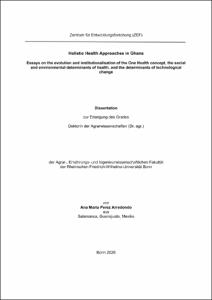
Holistic Health Approaches in GhanaEssays on the evolution and institutionalisation of the One Health concept, the social and environmental determinants of health, and the determinants of technological change
Holistic Health Approaches in Ghana
Essays on the evolution and institutionalisation of the One Health concept, the social and environmental determinants of health, and the determinants of technological change
| dc.contributor.advisor | Bender, Katja | |
| dc.contributor.author | Perez Arredondo, Ana Maria | |
| dc.date.accessioned | 2026-04-02T15:36:16Z | |
| dc.date.issued | 02.04.2026 | |
| dc.identifier.uri | https://hdl.handle.net/20.500.11811/14073 | |
| dc.description.abstract | This thesis examines holistic health approaches in Ghana, specifically One Health and Eco-Health, guided by three interrelated research objectives through a series of essays corresponding to five chapters. The first objective traces the evolution of One Health and intersectoral collaborations across emergencies, comparative contexts, and institutional changes, examining whether One Health can be sustained beyond emergencies and which narratives and stakeholders influence policy implementation. The second objective, from a Eco-Health view, identifies how social and environmental determinants mediate health behaviours at community levels, and the third objective assesses factors influencing renewable energy adoption in health facilities, particularly photovoltaic systems as pathways toward reliable, low-carbon healthcare delivery. Chapter 2 presents a systematic literature review of One Health approaches across SARS, MERS, and COVID-19 outbreaks. The analysis revealed three dominant framings: institutional coordination and collaboration, implementation-focused actions for disease control, and extended approaches incorporating environmental dimensions. Chapter 3 compares Ghana and India across rabies control, avian influenza management, and flood and drought responses to illuminate how governance structures shape intersectoral collaboration trajectories. The comparison identified enabling conditions for effective collaboration: concrete shared problems, guiding frameworks, coordinating authorities, adequate resources, and sustained political commitment. Chapter 4 examines the evolution of One Health narratives in Ghana from 2000 to 2025. Among the distinct narratives identified, crisis-response narratives dominated, reflecting experiences and the establishment of capacities to deal with disease outbreaks and mobilize resources for response, at the cost of creating dependencies privileging emergency preparedness over endemic challenges and environmental prevention. Chapter 5 analyses how social and environmental factors mediate healthcare utilisation through household surveys from 1,200 households in Accra. Mediation analysis revealed that environmental risk perception predicted social capital formation, which influenced healthcare utilisation patterns. However, the results were not conclusive. Chapter 6 examines renewable energy preferences through a discrete choice experiment with 193 private and faith-based health facilities. Reliability improvements emerged as the dominant driver of photovoltaic adoption, consistently outweighing cost considerations. Geographic heterogeneity was pronounced, with middle belt facilities exhibiting lower adoption propensity while northern facilities preferred higher solar coverage. The evidence presented in this thesis shows that the implementation of holistic approaches in Ghana requires concrete shared problems, dedicated resources, and deliberate efforts to connect global policy mandates with local realities. Ghana's experience demonstrates that sustained intersectoral collaboration depends on reshaping the narratives and resource structures toward environmental and social determinants that shape population health. | en |
| dc.language.iso | eng | |
| dc.rights | Attribution-NonCommercial-NoDerivatives 4.0 International | |
| dc.rights.uri | http://creativecommons.org/licenses/by-nc-nd/4.0/ | |
| dc.subject.ddc | 630 Landwirtschaft, Veterinärmedizin | |
| dc.title | Holistic Health Approaches in Ghana | |
| dc.title.alternative | Essays on the evolution and institutionalisation of the One Health concept, the social and environmental determinants of health, and the determinants of technological change | |
| dc.type | Dissertation oder Habilitation | |
| dc.identifier.doi | https://doi.org/10.48565/bonndoc-841 | |
| dc.publisher.name | Universitäts- und Landesbibliothek Bonn | |
| dc.publisher.location | Bonn | |
| dc.rights.accessRights | embargoedAccess | |
| dc.date.embargoEndDate | 15.04.2027 | |
| dc.identifier.urn | https://nbn-resolving.org/urn:nbn:de:hbz:5-89499 | |
| dc.relation.doi | https://doi.org/10.1016/j.onehlt.2020.100170 | |
| dc.relation.doi | https://doi.org/10.1016/j.onehlt.2021.100272 | |
| dc.relation.doi | https://doi.org/10.3389/fpubh.2026.1756550 | |
| ulbbn.pubtype | Erstveröffentlichung | |
| ulbbnediss.affiliation.name | Rheinische Friedrich-Wilhelms-Universität Bonn | |
| ulbbnediss.affiliation.location | Bonn | |
| ulbbnediss.thesis.level | Dissertation | |
| ulbbnediss.dissID | 8949 | |
| ulbbnediss.date.accepted | 29.01.2026 | |
| ulbbnediss.institute | Zentrale wissenschaftliche Einrichtungen : Zentrum für Entwicklungsforschung (ZEF) | |
| ulbbnediss.fakultaet | Agrar-, Ernährungs- und Ingenieurwissenschaftliche Fakultät | |
| dc.contributor.coReferee | Borgemeister, Christian | |
| ulbbnediss.contributor.orcid | https://orcid.org/0000-0001-7022-5406 |
Files in this item
This document has got an embargo.
This item appears in the following Collection(s)
-
E-Dissertationen (1182)
The following license files are associated with this item: