

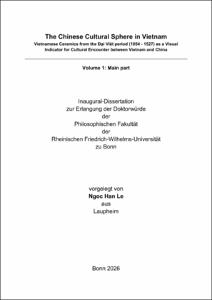
The Chinese Cultural Sphere in VietnamVietnamese Ceramics from the Đại Việt period (1054 - 1527) as a Visual Indicator for Cultural Encounter between Vietnam and China

The Chinese Cultural Sphere in Vietnam
Vietnamese Ceramics from the Đại Việt period (1054 - 1527) as a Visual Indicator for Cultural Encounter between Vietnam and China
| dc.contributor.advisor | Walker, Bethany | |
| dc.contributor.author | Le, Ngoc Han | |
| dc.date.accessioned | 2026-04-08T13:01:22Z | |
| dc.date.available | 2026-04-08T13:01:22Z | |
| dc.date.issued | 08.04.2026 | |
| dc.identifier.uri | https://hdl.handle.net/20.500.11811/14084 | |
| dc.description.abstract | Vietnam and China were intertwined throughout their long history. The past relationship between Vietnam and China is marked by confrontation and liberation struggles. This power struggle had a tremendous impact on Vietnamese history and culture. Historically Vietnam has been a part of the Chinese Cultural Sphere. The development of specialized ceramic production in Vietnam is closely related to the interaction with China. Vietnamese ceramics from the Lý dynasty (1009 - 1225), Trần dynasty (1225 - 1400), and Primal Lê dynasty (1428 - 1527) are a central objective of this study. Although Vietnamese ceramic culture has a long tradition, Vietnamese ceramic culture is little researched, especially in the context of Chinese ceramic culture. Little is known about the Vietnamese organization, production, and distribution of ceramic products. This research project aims to shed new light on an old tradition of Vietnam and to show the deep cultural entanglement between Vietnam and China. The evolution of glazed ceramics in Vietnam does have parallels with the evolution of Chinese ceramics and Vietnamese ceramic culture is strongly shaped by the Chinese, however, it is still independent. Hence, the usage and choice of decorative motifs are similar to Chinese ceramic culture but still showcase a separate ceramic culture. Additionally, the purpose of this project is to provide insights into the knowledge transfer between these two countries and the role of Vietnam in the Southeast Asian maritime trade. The data for this project was collected through extensive data collection of the excavated ceramic objects of the Imperial Citadel of Thăng Long and through gathering information about Chinese ceramic production, as there are few to no sources about Vietnamese ceramic production. The analysis of these components allows an insight into the Vietnamese organization of ceramic production and its distribution, the knowledge transfer between China and Vietnam, and Vietnam's role in the Southeast Asian trade market. In particular, the motif discoveries on Vietnamese ceramics assisted these understandings. These findings indicate that because Vietnamese ceramics have such parallels with the evolution of Chinese ceramics, Vietnam also operated official kilns. The kilns in Vietnam also had imperial patronage, affirmed by ceramic objects with official kiln marks in Vietnam. The Vietnamese ceramic production was not a competitor for the Chinese ceramic commercial market, nevertheless, they could deliver orders in large quantities too. Furthermore, it attests to the ability of the diversity of Vietnamese glaze types and the ability of Vietnamese potters to adjust to the global market. | en |
| dc.language.iso | eng | |
| dc.rights | In Copyright | |
| dc.rights.uri | http://rightsstatements.org/vocab/InC/1.0/ | |
| dc.subject | Vietnam | |
| dc.subject | China | |
| dc.subject | Keramik | |
| dc.subject | Materielle Kultur | |
| dc.subject.ddc | 730 Plastik, Numismatik, Keramik, Metallkunst | |
| dc.title | The Chinese Cultural Sphere in Vietnam | |
| dc.title.alternative | Vietnamese Ceramics from the Đại Việt period (1054 - 1527) as a Visual Indicator for Cultural Encounter between Vietnam and China | |
| dc.type | Dissertation oder Habilitation | |
| dc.identifier.doi | https://doi.org/10.48565/bonndoc-846 | |
| dc.publisher.name | Universitäts- und Landesbibliothek Bonn | |
| dc.publisher.location | Bonn | |
| dc.rights.accessRights | openAccess | |
| dc.identifier.urn | https://nbn-resolving.org/urn:nbn:de:hbz:5-88856 | |
| ulbbn.pubtype | Erstveröffentlichung | |
| ulbbnediss.affiliation.name | Rheinische Friedrich-Wilhelms-Universität Bonn | |
| ulbbnediss.affiliation.location | Bonn | |
| ulbbnediss.thesis.level | Dissertation | |
| ulbbnediss.dissID | 8885 | |
| ulbbnediss.date.accepted | 11.09.2024 | |
| ulbbnediss.institute | Philosophische Fakultät : Institut für Orient- und Asienwissenschaften (IOA) | |
| ulbbnediss.fakultaet | Philosophische Fakultät | |
| dc.contributor.coReferee | Miksic, John |
Files in this item

This item appears in the following Collection(s)
-
E-Dissertationen (736)
The following license files are associated with this item: