

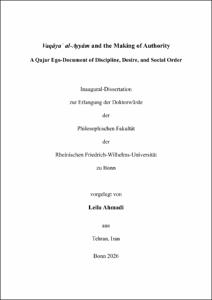
Vaqāyaʿ al-Ayyām and the Making of AuthorityA Qajar Ego-Document of Discipline, Desire, and Social Order

Vaqāyaʿ al-Ayyām and the Making of Authority
A Qajar Ego-Document of Discipline, Desire, and Social Order
 Dokument öffnen (12.3MB)
Art der Hochschulschrift
DissertationPrüfungsdatum
14.06.2023Datum der Veröffentlichung
20.04.2026Erstgutachter
Kollatz, AnnaZweitgutachter
Conermann, StephanMetadaten
Zur Langanzeige
Zitierbare Links 
Inhalt
This book emerged from a long-standing scholarly and personal engagement with one of the most elusive—and yet revealing—sources of late Qajar Iran: the manuscript Vaqāyaʿ al-Ayyām, composed by Shaykh al-Islām Manṣūr Qazvīnī between 1891 and 1895. What began as a dissertation has evolved into a broader intellectual project: an effort to bring literary form into sustained dialogue with political history and with the microstructures of power embedded in personal narrative.
My initial encounter with the manuscript was marked by both fascination and frustration: fascination with its shifting registers of travel writing, bureaucratic record, and private reflection; frustration with the interpretive and paleographic challenges such a document presents. Over time, these challenges became central to my understanding of the text's significance—not as a limitation, but as a feature of its richness. Vaqāyaʿ al-Ayyām is not a polished chronicle nor a conventional court history. It is a text born of movement, observation, ambition, and negotiation. It speaks in multiple voices: as witness to power, as agent of the state, as moral self-scrutinizer, and at times, as participant in and beneficiary of the very systems it documents.
The decision to frame this book around the themes of power, gender, and narrative was not made lightly. Qajar historiography has rightly emphasized modernization, state-building, and foreign intervention. Yet the manuscript at the centre of this study offers a different kind of evidence—intimate, ambiguous, and affectively charged—through which the operations of authority become visible in everyday scenes. Qazvīnī’s writing draws together administrative routine and social life, official duty and private self-presentation, coercion and persuasion, devotion and desire. Reading these elements together makes it possible to ask not only what the author reports, but how he constructs a legible world of hierarchy, obligation, vulnerability, and privilege.
This book is intended primarily for scholars of Iranian history, gender, and political thought, as well as readers interested in how authority is narrated, performed, and negotiated within the textures of daily life. Above all, it treats Vaqāyaʿ al-Ayyām as a manuscript that does more than preserve events: it stages the making of social and political order in the act of writing itself.
My initial encounter with the manuscript was marked by both fascination and frustration: fascination with its shifting registers of travel writing, bureaucratic record, and private reflection; frustration with the interpretive and paleographic challenges such a document presents. Over time, these challenges became central to my understanding of the text's significance—not as a limitation, but as a feature of its richness. Vaqāyaʿ al-Ayyām is not a polished chronicle nor a conventional court history. It is a text born of movement, observation, ambition, and negotiation. It speaks in multiple voices: as witness to power, as agent of the state, as moral self-scrutinizer, and at times, as participant in and beneficiary of the very systems it documents.
The decision to frame this book around the themes of power, gender, and narrative was not made lightly. Qajar historiography has rightly emphasized modernization, state-building, and foreign intervention. Yet the manuscript at the centre of this study offers a different kind of evidence—intimate, ambiguous, and affectively charged—through which the operations of authority become visible in everyday scenes. Qazvīnī’s writing draws together administrative routine and social life, official duty and private self-presentation, coercion and persuasion, devotion and desire. Reading these elements together makes it possible to ask not only what the author reports, but how he constructs a legible world of hierarchy, obligation, vulnerability, and privilege.
This book is intended primarily for scholars of Iranian history, gender, and political thought, as well as readers interested in how authority is narrated, performed, and negotiated within the textures of daily life. Above all, it treats Vaqāyaʿ al-Ayyām as a manuscript that does more than preserve events: it stages the making of social and political order in the act of writing itself.
Klassifikation (DDC)
950 Geschichte AsiensAhmadi, Leila: Vaqāyaʿ al-Ayyām and the Making of Authority : A Qajar Ego-Document of Discipline, Desire, and Social Order. - Bonn, 2026. - Dissertation, Rheinische Friedrich-Wilhelms-Universität Bonn.
Online-Ausgabe in bonndoc: https://nbn-resolving.org/urn:nbn:de:hbz:5-89536
Online-Ausgabe in bonndoc: https://nbn-resolving.org/urn:nbn:de:hbz:5-89536
@phdthesis{handle:20.500.11811/14108,
urn: https://nbn-resolving.org/urn:nbn:de:hbz:5-89536,
author = {{Leila Ahmadi}},
title = {Vaqāyaʿ al-Ayyām and the Making of Authority : A Qajar Ego-Document of Discipline, Desire, and Social Order},
school = {Rheinische Friedrich-Wilhelms-Universität Bonn},
year = 2026,
month = apr,
note = {This book emerged from a long-standing scholarly and personal engagement with one of the most elusive—and yet revealing—sources of late Qajar Iran: the manuscript Vaqāyaʿ al-Ayyām, composed by Shaykh al-Islām Manṣūr Qazvīnī between 1891 and 1895. What began as a dissertation has evolved into a broader intellectual project: an effort to bring literary form into sustained dialogue with political history and with the microstructures of power embedded in personal narrative.
My initial encounter with the manuscript was marked by both fascination and frustration: fascination with its shifting registers of travel writing, bureaucratic record, and private reflection; frustration with the interpretive and paleographic challenges such a document presents. Over time, these challenges became central to my understanding of the text's significance—not as a limitation, but as a feature of its richness. Vaqāyaʿ al-Ayyām is not a polished chronicle nor a conventional court history. It is a text born of movement, observation, ambition, and negotiation. It speaks in multiple voices: as witness to power, as agent of the state, as moral self-scrutinizer, and at times, as participant in and beneficiary of the very systems it documents.
The decision to frame this book around the themes of power, gender, and narrative was not made lightly. Qajar historiography has rightly emphasized modernization, state-building, and foreign intervention. Yet the manuscript at the centre of this study offers a different kind of evidence—intimate, ambiguous, and affectively charged—through which the operations of authority become visible in everyday scenes. Qazvīnī’s writing draws together administrative routine and social life, official duty and private self-presentation, coercion and persuasion, devotion and desire. Reading these elements together makes it possible to ask not only what the author reports, but how he constructs a legible world of hierarchy, obligation, vulnerability, and privilege.
This book is intended primarily for scholars of Iranian history, gender, and political thought, as well as readers interested in how authority is narrated, performed, and negotiated within the textures of daily life. Above all, it treats Vaqāyaʿ al-Ayyām as a manuscript that does more than preserve events: it stages the making of social and political order in the act of writing itself.},
url = {https://hdl.handle.net/20.500.11811/14108}
}
urn: https://nbn-resolving.org/urn:nbn:de:hbz:5-89536,
author = {{Leila Ahmadi}},
title = {Vaqāyaʿ al-Ayyām and the Making of Authority : A Qajar Ego-Document of Discipline, Desire, and Social Order},
school = {Rheinische Friedrich-Wilhelms-Universität Bonn},
year = 2026,
month = apr,
note = {This book emerged from a long-standing scholarly and personal engagement with one of the most elusive—and yet revealing—sources of late Qajar Iran: the manuscript Vaqāyaʿ al-Ayyām, composed by Shaykh al-Islām Manṣūr Qazvīnī between 1891 and 1895. What began as a dissertation has evolved into a broader intellectual project: an effort to bring literary form into sustained dialogue with political history and with the microstructures of power embedded in personal narrative.
My initial encounter with the manuscript was marked by both fascination and frustration: fascination with its shifting registers of travel writing, bureaucratic record, and private reflection; frustration with the interpretive and paleographic challenges such a document presents. Over time, these challenges became central to my understanding of the text's significance—not as a limitation, but as a feature of its richness. Vaqāyaʿ al-Ayyām is not a polished chronicle nor a conventional court history. It is a text born of movement, observation, ambition, and negotiation. It speaks in multiple voices: as witness to power, as agent of the state, as moral self-scrutinizer, and at times, as participant in and beneficiary of the very systems it documents.
The decision to frame this book around the themes of power, gender, and narrative was not made lightly. Qajar historiography has rightly emphasized modernization, state-building, and foreign intervention. Yet the manuscript at the centre of this study offers a different kind of evidence—intimate, ambiguous, and affectively charged—through which the operations of authority become visible in everyday scenes. Qazvīnī’s writing draws together administrative routine and social life, official duty and private self-presentation, coercion and persuasion, devotion and desire. Reading these elements together makes it possible to ask not only what the author reports, but how he constructs a legible world of hierarchy, obligation, vulnerability, and privilege.
This book is intended primarily for scholars of Iranian history, gender, and political thought, as well as readers interested in how authority is narrated, performed, and negotiated within the textures of daily life. Above all, it treats Vaqāyaʿ al-Ayyām as a manuscript that does more than preserve events: it stages the making of social and political order in the act of writing itself.},
url = {https://hdl.handle.net/20.500.11811/14108}
}
Die folgenden Nutzungsbestimmungen sind mit dieser Ressource verbunden: