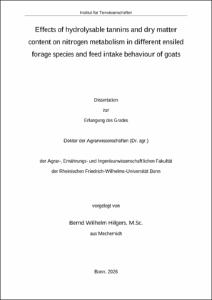
Effects of hydrolysable tannins and dry matter content on nitrogen metabolism in different ensiled forage species and feed intake behaviour of goats

Effects of hydrolysable tannins and dry matter content on nitrogen metabolism in different ensiled forage species and feed intake behaviour of goats
| dc.contributor.advisor | Südekum, Karl-Heinz | |
| dc.contributor.author | Hilgers, Bernd Wilhelm | |
| dc.date.accessioned | 2026-05-08T10:35:33Z | |
| dc.date.available | 2026-05-08T10:35:33Z | |
| dc.date.issued | 08.05.2026 | |
| dc.identifier.uri | https://hdl.handle.net/20.500.11811/14130 | |
| dc.description.abstract | Ensiled grass and legume forages are key components of ruminant diets, providing locally available, resource-efficient sources of crude protein (CP), energy and fibre. However, inevitable degradation and conversion processes occur during the ensiling process, due to plant-derived and microbial enzyme activity, leading to proteolysis of CP. An extensive degradation of CP must be critically considered, as this process results in reduced feed intake and nitrogen use efficiency. The objective of the present thesis was to ascertain to which extent a treatment of forages with a hydrolysable tannin (HT) extract influenced fermentation and protein quality, as well as the feed choice behaviour of goats, under varying ensiling conditions. The initial focus was therefore on a comprehensive chemical characterisation of the prepared lucerne, Italian ryegrass and red clover silage treatments. It was demonstrated that increasing the dry matter (DM) content of plant material from 200 to 350 g/kg prior to ensiling significantly improved fermentation quality and gas production. Meanwhile, adding HT up to 40 g/kg DM was found to have a positive impact on protein quality due to a restricted accumulation of non-protein-nitrogen (NPN) compounds. The impact of the pre-ensiling treatments on the feed choice behaviour and short-term DM intake of goats was subsequently investigated in three independent feeding trials. The animals showed a significantly higher preference and feed consumption for treatments with a higher DM content, whereby this observation was particularly pronounced in legume silages. This was due to the enhanced fermentation quality of high DM silages, as the formation of volatile fermentation products such as acetic acid and ammonia-nitrogen (NH3-N), which were negatively associated with silage quality and short-term DM intake of goats, were considerably reduced due to field wilting. On the other hand, the application of HT prior to the ensiling only led to a higher feed intake in low DM silages. The final study involved a detailed examination of the formation of free amino acids (AA) and biogenic amines (BA) in all pre-ensiling treatments. The highest amounts of individual and total BA were consistently detected in low DM silages, with the highest concentrations in lucerne and lowest in red clover silages. In addition to increasing the DM content, HT treatment also significantly impaired proteolytic activity during the ensiling process, as the accumulation of free AA, ℽ-aminobutyric acid and BA was markedly reduced. Furthermore, multiple regression analysis clarified that NPN compounds, such as NH3-N and BA were valid indicators for the acceptance and DM intake of silages in feed choice behaviour trials. Overall, the findings indicate that both the fermentation and protein quality of ensiled forages and the subsequent feed intake can be systematically enhanced by pre-ensiling treatments, which offers potential for further research and practical use. | en |
| dc.language.iso | eng | |
| dc.rights | In Copyright | |
| dc.rights.uri | http://rightsstatements.org/vocab/InC/1.0/ | |
| dc.subject | Hydrolysierbare Tannine | |
| dc.subject | Silage | |
| dc.subject | Proteolyse | |
| dc.subject | Ziegen | |
| dc.subject | Biogene Amine | |
| dc.subject | Trockenmasse | |
| dc.subject | Stickstoff | |
| dc.subject | Hydrolysable tannins | |
| dc.subject | silage | |
| dc.subject | proteolysis | |
| dc.subject | goats | |
| dc.subject | biogenic amines | |
| dc.subject | nitrogen | |
| dc.subject.ddc | 630 Landwirtschaft, Veterinärmedizin | |
| dc.title | Effects of hydrolysable tannins and dry matter content on nitrogen metabolism in different ensiled forage species and feed intake behaviour of goats | |
| dc.type | Dissertation oder Habilitation | |
| dc.publisher.name | Universitäts- und Landesbibliothek Bonn | |
| dc.publisher.location | Bonn | |
| dc.rights.accessRights | openAccess | |
| dc.identifier.urn | https://nbn-resolving.org/urn:nbn:de:hbz:5-89889 | |
| dc.relation.doi | https://doi.org/10.1016/j.anifeedsci.2025.116430 | |
| ulbbn.pubtype | Erstveröffentlichung | |
| ulbbnediss.affiliation.name | Rheinische Friedrich-Wilhelms-Universität Bonn | |
| ulbbnediss.affiliation.location | Bonn | |
| ulbbnediss.thesis.level | Dissertation | |
| ulbbnediss.dissID | 8988 | |
| ulbbnediss.date.accepted | 17.04.2026 | |
| ulbbnediss.institute | Agrar-, Ernährungs- und Ingenieurwissenschaftliche Fakultät : Institut für Tierwissenschaften (ITW) | |
| ulbbnediss.fakultaet | Agrar-, Ernährungs- und Ingenieurwissenschaftliche Fakultät | |
| dc.contributor.coReferee | Spiekers, Hubert | |
| ulbbnediss.contributor.orcid | https://orcid.org/0009-0005-5481-7926 |
Files in this item
This item appears in the following Collection(s)
-
E-Dissertationen (1188)
The following license files are associated with this item: