

Suche
Anzeige der Dokumente 1-10 von 35
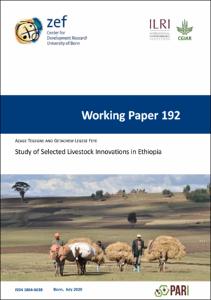
Study of Selected Livestock Innovations in Ethiopia
(2020-07)
Ethiopia is endowed with significant livestock resources and holds the largest livestock population in Africa, estimated at around 60 million cattle, 60 million sheep and goats, 52 million chickens, 4.5 million camels, 10 ...
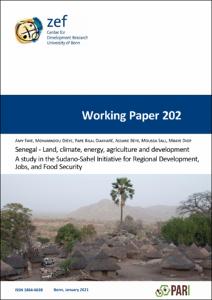
Senegal – Land, climate, energy, agriculture and development: A study in the Sudano-Sahel Initiative for Regional Development, Jobs, and Food Security
(2021-01)
Located in West Africa, Senegal is classified as a least-developed country that has historically had political stability and slow economic growth compared to the rest of Sub-Saharan Africa (SSA). However, from 2012 onward, ...
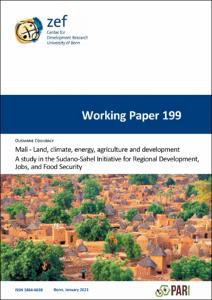
Mali – Land, climate, energy, agriculture and development: A study in the Sudano-Sahel Initiative for Regional Development, Jobs, and Food Security
(2021-01)
Mali is a Sub-Saharan African country with 19.1 million people. Almost half of this population lives in
poverty, due to the dysfunction of activity sectors (agriculture, energy, education, employment,
services, etc.). ...
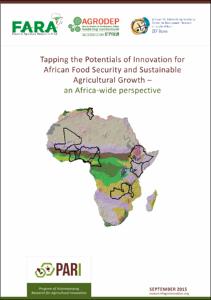
Tapping Potentials of Innovation for African Food Security and Sustainable Agricultural Growth: an Africa-wide Perspective
(2015-09)
While in the past, increased use of inputs and expansion of agricultural land accounted for a good part of agricultural growth in Africa, improvements in productivity will need to be a major driver of growth in the future. ...
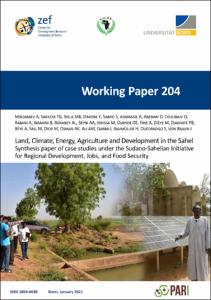
Land, Climate, Energy, Agriculture and Development in the Sahel: Synthesis paper of case studies under the Sudano-Sahelian Initiative for Regional Development, Jobs, and Food Security
(2021-01)
This paper synthesizes a set of national case studies conducted in the Sahelian countries during 2019-2020 as a collaboration between national universities and research institutes, and the Center for Development Research ...
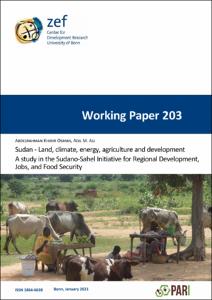
Sudan - Land, climate, energy, agriculture and development: A study in the Sudano-Sahel Initiative for Regional Development, Jobs, and Food Security
(2021-01)
Sudan is situated in Sub-Saharan Africa, covering an area of about 1.9 million km2 and has a population of 43 million. It is regarded as one of the countries in the world where human development is least advanced ...
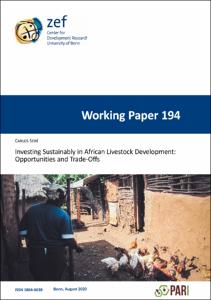
Investing Sustainably in African Livestock Development: Opportunities and Trade-Offs
(2020-08)
The production and consumption of animal source foods is central to the ongoing discussion of global food systems. The objectives of this report are first to describe the patterns and changing structures of the Sub-Saharan ...
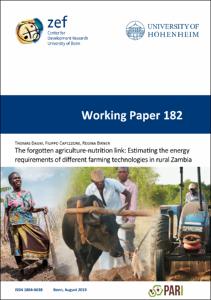
The forgotten agriculture-nutrition link: Estimating the energy requirements of different farming technologies in rural Zambia with time-use data
(2019-08)
In the quest to reduce global under- and malnutrition, which is particularly high among smallholder farmers, agriculture-nutrition linkages have received a lot of attention in recent years. Researchers have analysed the ...
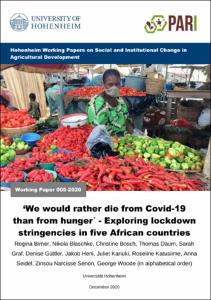
‘We would rather die from Covid-19 than from hunger ́ - Exploring lockdown stringencies in five African countries
(2020-12)
Facing the first wave of COVID-19, African countries were confronted with a dilemma: enacting strict lockdowns in order to “flatten the curve” could lead to a potentially severe drop in food security. Given this catch-22 ...
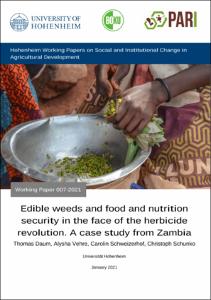
Edible weeds and food and nutrition security in the face of the herbicide revolution: A case study from Zambia
(2021-01)
Herbicides are on the rise across the developing world. Herbicides may come with several advantages, for example, they may help to improve yields, thereby contributing to food and nutrition security. However, they may ...