

Investigating multiple stressor effects at the molecular levelTranscriptomic profiling of freshwater macroinvertebrate species exposed to anthropogenic stressors

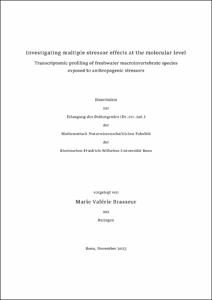
Investigating multiple stressor effects at the molecular level
Transcriptomic profiling of freshwater macroinvertebrate species exposed to anthropogenic stressors
| dc.contributor.advisor | Misof, Bernhard | |
| dc.contributor.author | Brasseur, Marie Valérie | |
| dc.date.accessioned | 2024-07-29T08:38:02Z | |
| dc.date.available | 2024-07-29T08:38:02Z | |
| dc.date.issued | 29.07.2024 | |
| dc.identifier.uri | https://hdl.handle.net/20.500.11811/11760 | |
| dc.description.abstract | Freshwater ecosystems are simultaneously exposed to multiple anthropogenic stressors, resulting in a global decline of freshwater biodiversity. Identifying the drivers of stream ecosystem deterioration is challenging because the impact of stressors depends on their abiotic and biotic context. For instance, stressors can induce indirect effects through trophic cascades or act in concert, i.e., weaken (antagonism) or amplify (synergism) each other. Semi-natural mesocosm field experiments have gained momentum in multiple stressor research because they allow the controlled manipulation of environmental stressor levels while incorporating sufficient natural complexity to obtain realistic estimates of stressor effects. In these experiments, stressor effects are often quantified based on specimen abundance changes following stressor exposure. However, relying only on specimen abundance changes can be misleading because organisms have physiological protective pathways, allowing them to withstand unfavourable habitat conditions for some time. In contrast, physiological responses have a higher temporal resolution and can inform about sublethal stressor effects. Therefore, this thesis focuses on the molecular basis of stressor-induced physiological response mechanisms through the integration of RNA-sequencing in the framework of ecological experiments. Transcriptomic profiling was performed in selected freshwater macroinvertebrate species (i.e., the caddisfly Lepidostoma basale, the mayfly Ephemera danica and the amphipods Gammarus fossarum and G. pulex), which all belong to taxonomically underexplored groups in the field of genomics. For such non-model organisms, appropriate data analyses pipelines must be purpose built. Therefore, a bioinformatic data processing workflow was established in Chapter 2. In the following chapter, a mesocosm field experiment was performed to assess the impact of fine sediment deposition, reduced flow velocity and increased salinity on the gene expression profile of G. fossarum. Because the stressor effects were already quantified at the population level, it was possible to differentiate between stressor effects which were consistent across ecological scales and stressor effects which were only detected at the transcriptomic level. Reduced flow velocity compensated the transcriptional profile of increased fine sediment, an antagonistic stressor interaction that was also detected based on specimen abundance patterns. Further, increased salinity induced, by far, the strongest transcriptomic response, contrasting stressor effects at the specimen abundance level where no salinity-induced change was observed. In the following two complementary chapters, RNA-sequencing was used to quantify exposure effects of the insecticide chlorantraniliprole, a globally applied control agent against butterfly pest species, under different abiotic and biotic contexts: in Chapter 4, chlorantraniliprole-induced transcriptional alterations in L. basale, E. danica and G. pulex were studied in an indoor experiment. Here, well-controlled experimental conditions allowed a precise estimation of the insecticide effect and enabled further to test whether interspecific competition between the two leaf-shredding species G. pulex and L. basale modulates their insecticide-induced expression profiles. In Chapter 5, a mesocosm field experiment was used to study multiple stressor effects of chlorantraniliprole and increased fine sediment load on the gene expression profiles of L. basale and G. pulex under near-natural conditions. In both experiments, G. pulex (Chapter 4 and 5) was only weakly affected by the insecticide stressor. In contrast, the aquatic insects E. danica (Chapter 4) and L. basale (Chapter 4 and 5) showed strong transcriptional alterations following chlorantraniliprole exposure. This suggests that the impact of chlorantraniliprole on non-target taxa depends on the phylogenetic distance between the studied species and butterflies. Further, the indoor experiment showed that biotic interaction interferes with the insecticide-induced transcriptional stress response of L. basale, which was presumably the weaker competitor due to the strong insecticide-induced effect in this species (Chapter 4), whereas the mesocosm experiment revealed mainly antagonistic interactions between the insecticide stressor and increased fine sediment (Chapter 5). In conclusion, the studies in this thesis provide important mechanistic insights how multiple stressor exposure affects freshwater organisms, highlighting the potential of transcriptomics in the field of multiple stressor research. | en |
| dc.language.iso | eng | |
| dc.rights | Namensnennung 4.0 International | |
| dc.rights.uri | http://creativecommons.org/licenses/by/4.0/ | |
| dc.subject | Multiple Stressoren | |
| dc.subject | Fließgewässer | |
| dc.subject | aquatische Invertebraten | |
| dc.subject | transkriptomische Stressantwort | |
| dc.subject | Genexpression | |
| dc.subject | RNA-Sequenzierung | |
| dc.subject | Multiple stressors | |
| dc.subject | freshwater ecosystems | |
| dc.subject | aquatic invertebrates | |
| dc.subject | transcriptomic stress response | |
| dc.subject | gene expression | |
| dc.subject | RNA-sequencing | |
| dc.subject.ddc | 570 Biowissenschaften, Biologie | |
| dc.subject.ddc | 590 Tiere (Zoologie) | |
| dc.title | Investigating multiple stressor effects at the molecular level | |
| dc.title.alternative | Transcriptomic profiling of freshwater macroinvertebrate species exposed to anthropogenic stressors | |
| dc.type | Dissertation oder Habilitation | |
| dc.identifier.doi | https://doi.org/10.48565/bonndoc-340 | |
| dc.publisher.name | Universitäts- und Landesbibliothek Bonn | |
| dc.publisher.location | Bonn | |
| dc.rights.accessRights | openAccess | |
| dc.identifier.urn | https://nbn-resolving.org/urn:nbn:de:hbz:5-76849 | |
| dc.relation.doi | https://doi.org/10.1186/s12864-022-09050-1 | |
| dc.relation.doi | https://doi.org/10.1016/j.envpol.2023.122306 | |
| dc.relation.doi | https://doi.org/10.1186/s12302-023-00785-6 | |
| ulbbn.pubtype | Erstveröffentlichung | |
| ulbbnediss.affiliation.name | Rheinische Friedrich-Wilhelms-Universität Bonn | |
| ulbbnediss.affiliation.location | Bonn | |
| ulbbnediss.thesis.level | Dissertation | |
| ulbbnediss.dissID | 7684 | |
| ulbbnediss.date.accepted | 14.06.2024 | |
| ulbbnediss.institute | Angegliederte Institute, verbundene wissenschaftliche Einrichtungen : Zoologisches Forschungsmuseum Alexander Koenig (ZFMK) | |
| ulbbnediss.fakultaet | Mathematisch-Naturwissenschaftliche Fakultät | |
| dc.contributor.coReferee | Leese, Florian | |
| ulbbnediss.contributor.orcid | https://orcid.org/0000-0003-2044-4867 |
Files in this item
This item appears in the following Collection(s)
-
E-Dissertationen (4540)
The following license files are associated with this item: