
Wild pollination in agroecosystems with a focus on Brachycera and Hymenopteraan integrative approach

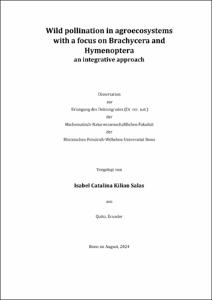
Wild pollination in agroecosystems with a focus on Brachycera and Hymenoptera
an integrative approach
 Dokument öffnen (9.5MB)
Art der Hochschulschrift
DissertationPrüfungsdatum
04.11.2024Datum der Veröffentlichung
26.11.2024Erstgutachter
Wägele, J. WolfgangZweitgutachter
Döring, ThomasMetadaten
Zur Langanzeige
Zitierbare Links 
Inhalt
Pollination is essential for angiosperm diversity and global crop production. However, agricultural intesification have led to a decline in pollinators, and an increased use of managed species. Hymenoptera (bees and wasps) and Brachycera (flies) are among the most prominent species found in agricultural landscapes. The which extent these species contribute to pollination is still relatively unknown. Moreover, potential pollinators interact with the targeted plant species and many other plant species, which can be analyzed as bipartite plant-pollinator networks. The networks’ structure can indicate the stability of plant-insect interactions as ecosystem functions and their resilience to external stressors. In this thesis, I used an integrative approach combining morphological identification, DNA barcoding, and metabarcoding to assess plant-pollinator networks. The aim was to analyze the plant-pollinator networks of all non-honeybee Hymenoptera and Brachycera of caraway (Carum carvi L.) and apple (Malus domestica BORKH.) in agroecosystems, including key species and temporal dynamics of the plant-pollinator networks. In the plant-pollinator networks of caraway, 34 Hymenoptera and 87 Brachycera potential pollinators interacted with 139 plant taxa (Chapter 2). The distinct qualitative differences of the pollen loads between Brachycera and Hymenoptera highlight the complementarity in flower affinity. Intraseasonal analyses of the interactions showed the potential of this crop as a food source for insect species outside the period of many early-flowering crop species. Finally, strong intraday differences in potential pollinator diversity emphasize the necessity of collecting insects at varying times of the day to create comprehensive plant-pollinator networks (Chapter 2). In the plant-pollinator networks of apple, 35 Hymenoptera and 66 Brachycera pollinating species interacted with 194 plant taxa (Chapter 3). Aside from the targeted crop species, other early-flowering plant taxa dominated the plant-pollinator networks, highlighting the importance of these species as food sources in early-flowering orchards. Despite not focusing on pollinator efficiency per se, diverse pollinator diversity can enhance the resilience of pollination as a key component of ecosystem functions in agroecosystems. A lack of recognition of the contribution of wild pollinators in agroecosystems has also impacted the development and implementation of conservation efforts; therefore, some recommendations for different stakeholders are discussed in Chapter 5. Metabarcoding can also be used to assess the insect diversity in bulk samples. To what extent samples examined with metabarcoding are comparable to those identified through morphological means has been relatively understudied. Therefore, Brachycera and Hymenoptera collected with Malaise trap on spinach fields (Spinacia oleracea L.) were analyzed and tested using a non-destructive metabarcoding approach and four different clustering and filtering approaches (Chapter 4). Depending on the selected approach, metabarcoding results regarding detected brachyceran and hymenopteran species strongly varied. Potential limitations of metabarcoding and possible solutions were further discussed (Chapter 5).
Schlagwörter
pollination ecology, bipartite and pollination networks, DNA barcoding, DNA metabarcoding, morphology, palynology
Klassifikation (DDC)
570 Biowissenschaften, Biologie 590 Tiere (Zoologie)Zugehörige Publikation(en)
https://doi.org/10.1111/mec.16943Kilian Salas, Isabel Catalina: Wild pollination in agroecosystems with a focus on Brachycera and Hymenoptera : an integrative approach. - Bonn, 2024. - Dissertation, Rheinische Friedrich-Wilhelms-Universität Bonn.
Online-Ausgabe in bonndoc: https://nbn-resolving.org/urn:nbn:de:hbz:5-79772
Online-Ausgabe in bonndoc: https://nbn-resolving.org/urn:nbn:de:hbz:5-79772
@phdthesis{handle:20.500.11811/12575,
urn: https://nbn-resolving.org/urn:nbn:de:hbz:5-79772,
doi: https://doi.org/10.48565/bonndoc-428,
author = {{Isabel Catalina Kilian Salas}},
title = {Wild pollination in agroecosystems with a focus on Brachycera and Hymenoptera : an integrative approach},
school = {Rheinische Friedrich-Wilhelms-Universität Bonn},
year = 2024,
month = nov,
note = {Pollination is essential for angiosperm diversity and global crop production. However, agricultural intesification have led to a decline in pollinators, and an increased use of managed species. Hymenoptera (bees and wasps) and Brachycera (flies) are among the most prominent species found in agricultural landscapes. The which extent these species contribute to pollination is still relatively unknown. Moreover, potential pollinators interact with the targeted plant species and many other plant species, which can be analyzed as bipartite plant-pollinator networks. The networks’ structure can indicate the stability of plant-insect interactions as ecosystem functions and their resilience to external stressors. In this thesis, I used an integrative approach combining morphological identification, DNA barcoding, and metabarcoding to assess plant-pollinator networks. The aim was to analyze the plant-pollinator networks of all non-honeybee Hymenoptera and Brachycera of caraway (Carum carvi L.) and apple (Malus domestica BORKH.) in agroecosystems, including key species and temporal dynamics of the plant-pollinator networks. In the plant-pollinator networks of caraway, 34 Hymenoptera and 87 Brachycera potential pollinators interacted with 139 plant taxa (Chapter 2). The distinct qualitative differences of the pollen loads between Brachycera and Hymenoptera highlight the complementarity in flower affinity. Intraseasonal analyses of the interactions showed the potential of this crop as a food source for insect species outside the period of many early-flowering crop species. Finally, strong intraday differences in potential pollinator diversity emphasize the necessity of collecting insects at varying times of the day to create comprehensive plant-pollinator networks (Chapter 2). In the plant-pollinator networks of apple, 35 Hymenoptera and 66 Brachycera pollinating species interacted with 194 plant taxa (Chapter 3). Aside from the targeted crop species, other early-flowering plant taxa dominated the plant-pollinator networks, highlighting the importance of these species as food sources in early-flowering orchards. Despite not focusing on pollinator efficiency per se, diverse pollinator diversity can enhance the resilience of pollination as a key component of ecosystem functions in agroecosystems. A lack of recognition of the contribution of wild pollinators in agroecosystems has also impacted the development and implementation of conservation efforts; therefore, some recommendations for different stakeholders are discussed in Chapter 5. Metabarcoding can also be used to assess the insect diversity in bulk samples. To what extent samples examined with metabarcoding are comparable to those identified through morphological means has been relatively understudied. Therefore, Brachycera and Hymenoptera collected with Malaise trap on spinach fields (Spinacia oleracea L.) were analyzed and tested using a non-destructive metabarcoding approach and four different clustering and filtering approaches (Chapter 4). Depending on the selected approach, metabarcoding results regarding detected brachyceran and hymenopteran species strongly varied. Potential limitations of metabarcoding and possible solutions were further discussed (Chapter 5).},
url = {https://hdl.handle.net/20.500.11811/12575}
}
urn: https://nbn-resolving.org/urn:nbn:de:hbz:5-79772,
doi: https://doi.org/10.48565/bonndoc-428,
author = {{Isabel Catalina Kilian Salas}},
title = {Wild pollination in agroecosystems with a focus on Brachycera and Hymenoptera : an integrative approach},
school = {Rheinische Friedrich-Wilhelms-Universität Bonn},
year = 2024,
month = nov,
note = {Pollination is essential for angiosperm diversity and global crop production. However, agricultural intesification have led to a decline in pollinators, and an increased use of managed species. Hymenoptera (bees and wasps) and Brachycera (flies) are among the most prominent species found in agricultural landscapes. The which extent these species contribute to pollination is still relatively unknown. Moreover, potential pollinators interact with the targeted plant species and many other plant species, which can be analyzed as bipartite plant-pollinator networks. The networks’ structure can indicate the stability of plant-insect interactions as ecosystem functions and their resilience to external stressors. In this thesis, I used an integrative approach combining morphological identification, DNA barcoding, and metabarcoding to assess plant-pollinator networks. The aim was to analyze the plant-pollinator networks of all non-honeybee Hymenoptera and Brachycera of caraway (Carum carvi L.) and apple (Malus domestica BORKH.) in agroecosystems, including key species and temporal dynamics of the plant-pollinator networks. In the plant-pollinator networks of caraway, 34 Hymenoptera and 87 Brachycera potential pollinators interacted with 139 plant taxa (Chapter 2). The distinct qualitative differences of the pollen loads between Brachycera and Hymenoptera highlight the complementarity in flower affinity. Intraseasonal analyses of the interactions showed the potential of this crop as a food source for insect species outside the period of many early-flowering crop species. Finally, strong intraday differences in potential pollinator diversity emphasize the necessity of collecting insects at varying times of the day to create comprehensive plant-pollinator networks (Chapter 2). In the plant-pollinator networks of apple, 35 Hymenoptera and 66 Brachycera pollinating species interacted with 194 plant taxa (Chapter 3). Aside from the targeted crop species, other early-flowering plant taxa dominated the plant-pollinator networks, highlighting the importance of these species as food sources in early-flowering orchards. Despite not focusing on pollinator efficiency per se, diverse pollinator diversity can enhance the resilience of pollination as a key component of ecosystem functions in agroecosystems. A lack of recognition of the contribution of wild pollinators in agroecosystems has also impacted the development and implementation of conservation efforts; therefore, some recommendations for different stakeholders are discussed in Chapter 5. Metabarcoding can also be used to assess the insect diversity in bulk samples. To what extent samples examined with metabarcoding are comparable to those identified through morphological means has been relatively understudied. Therefore, Brachycera and Hymenoptera collected with Malaise trap on spinach fields (Spinacia oleracea L.) were analyzed and tested using a non-destructive metabarcoding approach and four different clustering and filtering approaches (Chapter 4). Depending on the selected approach, metabarcoding results regarding detected brachyceran and hymenopteran species strongly varied. Potential limitations of metabarcoding and possible solutions were further discussed (Chapter 5).},
url = {https://hdl.handle.net/20.500.11811/12575}
}
Die folgenden Nutzungsbestimmungen sind mit dieser Ressource verbunden: