
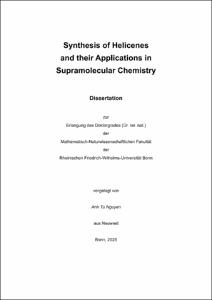
Synthesis of Helicenes and their Applications in Supramolecular Chemistry

Synthesis of Helicenes and their Applications in Supramolecular Chemistry
 Dokument öffnen (22.3MB)
Art der Hochschulschrift
DissertationPrüfungsdatum
12.12.2025Datum der Veröffentlichung
07.01.2026Erstgutachter
Lützen, ArneZweitgutachter
Höger, SigurdMetadaten
Zur Langanzeige
Zitierbare Links 
Inhalt
The aim of this work was the development of a reliable synthetic route towards functionalized helicenes, their characterization, chiral resolution and application as ligands in supramolecular chemistry.
Using two different strategies, a series of difunctionalized, racemic helicenes were synthesized and largely characterized. These range from racemic penta- to racemic heptahelicenes. The first strategy mainly relied on a nucleophilic addition of benzaldehydes and proved to be the superior one for the synthesis of penta- and heptahelicenes, whereas the second one involving a nucleophilic substitution of toluene derivatives was mandatory for the synthesis of hexahelicenes. The strategies were modular enough for the synthesis of different congeners. The pre-functionalized substrates each carried a methoxy group which guaranteed a late-stage functionalization and the introduction of donor atoms in the final step. A simple change in substitution pattern gave access to different regioisomers and donor angles. At the same time, the methoxy groups increased the solubility of the respective compounds in common organic solvents which was crucial for their chiral resolution by high performance liquid chromatography.
Following the synthesis of the ligands, investigations were made regarding their ability to form complexes with different metal ions. Out of the investigated helicenes in this work, two bidentate regioisomers based on heptahelicene were able to form polynuclear complexes with tetravalent, square planar PdII. A subtle change in donor positions had a drastic impact in donor angles which ultimately led to complexes of different compositions. A fixed donor angle of 180° in the first ligand L1 made it a suitable candidate as a ditopic rod for the construction of a molecular square Pd4(dppp)4(L1)4, whereas the variable donor angle in the second ligand L2 facilitated the construction of tri- and tetranuclear complexes Pd3(L2)6 und Pd4(L2)8 of different architectures, respectively. For each of these structures, a number of stereoisomers came on top as the presence of two enantiomers in each experiment resulted in the formation of different configurational isomers. Finally, the experiments were reiterated with the enantiopure compounds in order to get more insight on the exact processes and potential self-sorting phenomena. Synthese von Helicenen und ihre Anwendung in der Supramolekularen Chemie
Diese Arbeit beschäftigte sich mit der Entwicklung einer zuverlässigen Syntheseroute zu funktionalisierten Helicenen, deren Charakterisierung, chirale Trennung und Anwendung als Liganden in der supramolekularen Chemie.
Unter Einsatz zwei verschiedener Strategien wurde eine Reihe von difunktionalisierten, racemischen Helicenen synthetisiert und weitgehend charakterisiert. Diese reichen von racemischen Penta- bis zu racemischen Heptahelicenen. Die erste Strategie beruhte im Wesentlichen auf einer nukleophilen Addition von Benzaldehyden und erwies sich als die überlegene Methode für die Synthese von Penta- und Heptahelicenen, während die zweite Strategie, welche auf der nukleophilen Substitution von Toluolderivaten basierte, für die Synthese von Hexahelicenen erforderlich war. Die Methoden waren hinreichend modular, um die Synthese mehrerer Derivate zu ermöglichen. Die vorfunktionalisierten Substrate trugen jeweils eine Methoxygruppe, die eine späte Funktionalisierung und die Einführung von Donoratomen im letzten Schritt ermöglichte. Eine einfache Änderung des Substitutionsmusters erlaubte dabei den Zugang zu unterschiedlichen Regioisomeren und Donorwinkeln. Gleichzeitig erhöhten die Methoxygruppen die Löslichkeit der jeweiligen Verbindungen in gängigen organischen Lösemitteln, was entscheidend für die chirale Trennung mittels Hochleistungsflüssigkeitschromatographie war.
Nach der Synthese der Liganden wurden Untersuchungen bezüglich ihrer Fähigkeit, Komplexe mit verschiedenen Metallionen zu bilden, durchgeführt. Unter den in dieser Arbeit untersuchten Helicenen waren zwei bidentate Regioisomere mit dem Grundgerüst von Heptahelicen in der Lage, polynukleare Komplexe mit tetravalentem, quadratisch-planarem PdII zu bilden. Eine subtile Veränderung der Donorposition hatte dabei einen drastischen Einfluss auf die Donorwinkel, was letztendlich zu Komplexen mit unterschiedlicher Zusammensetzung führte. Ein fixer Donorwinkel von 180° im ersten Liganden L1 machte diesen zu einem geeigneten Baustein für die Synthese eines molekularen Quadrats Pd4(dppp)4(L1)4, während der variable Donorwinkel im zweiten Liganden L2 die Bildung von tri- und tetranuklearen Komplexen Pd3(L2)6 und Pd4(L2)8 unterschiedlicher Architektur ermöglichte. Für jede Struktur kam eine Vielzahl von Stereoisomeren dazu, da die Präsenz von zwei Enantiomeren in jedem Experiment zur Bildung unterschiedlicher Konfigurationsisomere führte. Abschließend wurden die Experimente mit den enantiomerenreinen Verbindungen wiederholt, um genauere Einblicke in die exakten Prozesse und mögliche Selbstsortierungsphänomene zu gewinnen.
Using two different strategies, a series of difunctionalized, racemic helicenes were synthesized and largely characterized. These range from racemic penta- to racemic heptahelicenes. The first strategy mainly relied on a nucleophilic addition of benzaldehydes and proved to be the superior one for the synthesis of penta- and heptahelicenes, whereas the second one involving a nucleophilic substitution of toluene derivatives was mandatory for the synthesis of hexahelicenes. The strategies were modular enough for the synthesis of different congeners. The pre-functionalized substrates each carried a methoxy group which guaranteed a late-stage functionalization and the introduction of donor atoms in the final step. A simple change in substitution pattern gave access to different regioisomers and donor angles. At the same time, the methoxy groups increased the solubility of the respective compounds in common organic solvents which was crucial for their chiral resolution by high performance liquid chromatography.
Following the synthesis of the ligands, investigations were made regarding their ability to form complexes with different metal ions. Out of the investigated helicenes in this work, two bidentate regioisomers based on heptahelicene were able to form polynuclear complexes with tetravalent, square planar PdII. A subtle change in donor positions had a drastic impact in donor angles which ultimately led to complexes of different compositions. A fixed donor angle of 180° in the first ligand L1 made it a suitable candidate as a ditopic rod for the construction of a molecular square Pd4(dppp)4(L1)4, whereas the variable donor angle in the second ligand L2 facilitated the construction of tri- and tetranuclear complexes Pd3(L2)6 und Pd4(L2)8 of different architectures, respectively. For each of these structures, a number of stereoisomers came on top as the presence of two enantiomers in each experiment resulted in the formation of different configurational isomers. Finally, the experiments were reiterated with the enantiopure compounds in order to get more insight on the exact processes and potential self-sorting phenomena.
Diese Arbeit beschäftigte sich mit der Entwicklung einer zuverlässigen Syntheseroute zu funktionalisierten Helicenen, deren Charakterisierung, chirale Trennung und Anwendung als Liganden in der supramolekularen Chemie.
Unter Einsatz zwei verschiedener Strategien wurde eine Reihe von difunktionalisierten, racemischen Helicenen synthetisiert und weitgehend charakterisiert. Diese reichen von racemischen Penta- bis zu racemischen Heptahelicenen. Die erste Strategie beruhte im Wesentlichen auf einer nukleophilen Addition von Benzaldehyden und erwies sich als die überlegene Methode für die Synthese von Penta- und Heptahelicenen, während die zweite Strategie, welche auf der nukleophilen Substitution von Toluolderivaten basierte, für die Synthese von Hexahelicenen erforderlich war. Die Methoden waren hinreichend modular, um die Synthese mehrerer Derivate zu ermöglichen. Die vorfunktionalisierten Substrate trugen jeweils eine Methoxygruppe, die eine späte Funktionalisierung und die Einführung von Donoratomen im letzten Schritt ermöglichte. Eine einfache Änderung des Substitutionsmusters erlaubte dabei den Zugang zu unterschiedlichen Regioisomeren und Donorwinkeln. Gleichzeitig erhöhten die Methoxygruppen die Löslichkeit der jeweiligen Verbindungen in gängigen organischen Lösemitteln, was entscheidend für die chirale Trennung mittels Hochleistungsflüssigkeitschromatographie war.
Nach der Synthese der Liganden wurden Untersuchungen bezüglich ihrer Fähigkeit, Komplexe mit verschiedenen Metallionen zu bilden, durchgeführt. Unter den in dieser Arbeit untersuchten Helicenen waren zwei bidentate Regioisomere mit dem Grundgerüst von Heptahelicen in der Lage, polynukleare Komplexe mit tetravalentem, quadratisch-planarem PdII zu bilden. Eine subtile Veränderung der Donorposition hatte dabei einen drastischen Einfluss auf die Donorwinkel, was letztendlich zu Komplexen mit unterschiedlicher Zusammensetzung führte. Ein fixer Donorwinkel von 180° im ersten Liganden L1 machte diesen zu einem geeigneten Baustein für die Synthese eines molekularen Quadrats Pd4(dppp)4(L1)4, während der variable Donorwinkel im zweiten Liganden L2 die Bildung von tri- und tetranuklearen Komplexen Pd3(L2)6 und Pd4(L2)8 unterschiedlicher Architektur ermöglichte. Für jede Struktur kam eine Vielzahl von Stereoisomeren dazu, da die Präsenz von zwei Enantiomeren in jedem Experiment zur Bildung unterschiedlicher Konfigurationsisomere führte. Abschließend wurden die Experimente mit den enantiomerenreinen Verbindungen wiederholt, um genauere Einblicke in die exakten Prozesse und mögliche Selbstsortierungsphänomene zu gewinnen.
Schlagwörter
Supramolekulare Chemie, Helicene, Organische Chemie, Synthese, helikale Chiralität, supramolecular chemistry, helicenes, organic chemistry, synthesis, helical chirality
Klassifikation (DDC)
540 ChemieNguyen, Anh Tu: Synthesis of Helicenes and their Applications in Supramolecular Chemistry. - Bonn, 2026. - Dissertation, Rheinische Friedrich-Wilhelms-Universität Bonn.
Online-Ausgabe in bonndoc: https://nbn-resolving.org/urn:nbn:de:hbz:5-87170
Online-Ausgabe in bonndoc: https://nbn-resolving.org/urn:nbn:de:hbz:5-87170
@phdthesis{handle:20.500.11811/13806,
urn: https://nbn-resolving.org/urn:nbn:de:hbz:5-87170,
author = {{Anh Tu Nguyen}},
title = {Synthesis of Helicenes and their Applications in Supramolecular Chemistry},
school = {Rheinische Friedrich-Wilhelms-Universität Bonn},
year = 2026,
month = jan,
note = {The aim of this work was the development of a reliable synthetic route towards functionalized helicenes, their characterization, chiral resolution and application as ligands in supramolecular chemistry.
Using two different strategies, a series of difunctionalized, racemic helicenes were synthesized and largely characterized. These range from racemic penta- to racemic heptahelicenes. The first strategy mainly relied on a nucleophilic addition of benzaldehydes and proved to be the superior one for the synthesis of penta- and heptahelicenes, whereas the second one involving a nucleophilic substitution of toluene derivatives was mandatory for the synthesis of hexahelicenes. The strategies were modular enough for the synthesis of different congeners. The pre-functionalized substrates each carried a methoxy group which guaranteed a late-stage functionalization and the introduction of donor atoms in the final step. A simple change in substitution pattern gave access to different regioisomers and donor angles. At the same time, the methoxy groups increased the solubility of the respective compounds in common organic solvents which was crucial for their chiral resolution by high performance liquid chromatography.
Following the synthesis of the ligands, investigations were made regarding their ability to form complexes with different metal ions. Out of the investigated helicenes in this work, two bidentate regioisomers based on heptahelicene were able to form polynuclear complexes with tetravalent, square planar PdII. A subtle change in donor positions had a drastic impact in donor angles which ultimately led to complexes of different compositions. A fixed donor angle of 180° in the first ligand L1 made it a suitable candidate as a ditopic rod for the construction of a molecular square Pd4(dppp)4(L1)4, whereas the variable donor angle in the second ligand L2 facilitated the construction of tri- and tetranuclear complexes Pd3(L2)6 und Pd4(L2)8 of different architectures, respectively. For each of these structures, a number of stereoisomers came on top as the presence of two enantiomers in each experiment resulted in the formation of different configurational isomers. Finally, the experiments were reiterated with the enantiopure compounds in order to get more insight on the exact processes and potential self-sorting phenomena.},
url = {https://hdl.handle.net/20.500.11811/13806}
}
urn: https://nbn-resolving.org/urn:nbn:de:hbz:5-87170,
author = {{Anh Tu Nguyen}},
title = {Synthesis of Helicenes and their Applications in Supramolecular Chemistry},
school = {Rheinische Friedrich-Wilhelms-Universität Bonn},
year = 2026,
month = jan,
note = {The aim of this work was the development of a reliable synthetic route towards functionalized helicenes, their characterization, chiral resolution and application as ligands in supramolecular chemistry.
Using two different strategies, a series of difunctionalized, racemic helicenes were synthesized and largely characterized. These range from racemic penta- to racemic heptahelicenes. The first strategy mainly relied on a nucleophilic addition of benzaldehydes and proved to be the superior one for the synthesis of penta- and heptahelicenes, whereas the second one involving a nucleophilic substitution of toluene derivatives was mandatory for the synthesis of hexahelicenes. The strategies were modular enough for the synthesis of different congeners. The pre-functionalized substrates each carried a methoxy group which guaranteed a late-stage functionalization and the introduction of donor atoms in the final step. A simple change in substitution pattern gave access to different regioisomers and donor angles. At the same time, the methoxy groups increased the solubility of the respective compounds in common organic solvents which was crucial for their chiral resolution by high performance liquid chromatography.
Following the synthesis of the ligands, investigations were made regarding their ability to form complexes with different metal ions. Out of the investigated helicenes in this work, two bidentate regioisomers based on heptahelicene were able to form polynuclear complexes with tetravalent, square planar PdII. A subtle change in donor positions had a drastic impact in donor angles which ultimately led to complexes of different compositions. A fixed donor angle of 180° in the first ligand L1 made it a suitable candidate as a ditopic rod for the construction of a molecular square Pd4(dppp)4(L1)4, whereas the variable donor angle in the second ligand L2 facilitated the construction of tri- and tetranuclear complexes Pd3(L2)6 und Pd4(L2)8 of different architectures, respectively. For each of these structures, a number of stereoisomers came on top as the presence of two enantiomers in each experiment resulted in the formation of different configurational isomers. Finally, the experiments were reiterated with the enantiopure compounds in order to get more insight on the exact processes and potential self-sorting phenomena.},
url = {https://hdl.handle.net/20.500.11811/13806}
}
Die folgenden Nutzungsbestimmungen sind mit dieser Ressource verbunden: