
Biomedical Relation Extraction Using Transfer Learning Methods

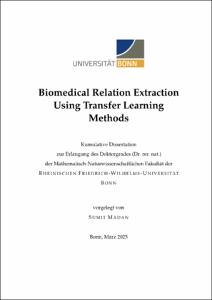
Biomedical Relation Extraction Using Transfer Learning Methods
 View/
View/Type of Scholarly Publication
DissertationDate of Exam
22.01.2026Date of Publication
26.02.2026Advisor
Hofmann-Apitius, MartinCo-Referee
Klein, ReinhardMetadata
Show full item record
Citable Links 
Abstract
The increasing volume of data in the biomedical field presents significant challenges related to information extraction and knowledge discovery. However, this large volume of data also offers substantial opportunities to enhance our understanding of disease mechanisms, identifying therapeutic targets, and advance precision medicine. To fully leverage these opportunities, advanced computational methodologies from the machine learning field are indispensable, allowing researchers to uncover valuable insights that would otherwise remain hidden.
This thesis explores the development and application of transfer learning methods - especially transformer-based models - for identifying and extracting relations from biomedical datasets. We contribute by providing a comprehensive review of the applications of transformer models across various biomedical subfields. Furthermore, we develop transformer-based methodologies in three experimental studies. Firstly, we implement a text mining workflow for extracting psychiatric attributes and psychopathological symptoms from German psychiatric reports, enabling secondary use of patient data in research. Secondly, we propose a Siamese architecture to predict virus-host protein-protein interactions using deep protein sequence embeddings, facilitating the prioritization of these interactions for drug discovery. Finally, we present an end-to-end text mining workflow designed to identify miRNA-disease associations from recent scientific literature, allowing to investigate the roles of miRNA in disease mechanisms.
In conclusion, the scientific advancements presented in this work demonstrate the potential of transformer-based methodologies for the data-driven extraction of valuable biological and medical relations, contributing to the advancement of knowledge in biomedicine.
This thesis explores the development and application of transfer learning methods - especially transformer-based models - for identifying and extracting relations from biomedical datasets. We contribute by providing a comprehensive review of the applications of transformer models across various biomedical subfields. Furthermore, we develop transformer-based methodologies in three experimental studies. Firstly, we implement a text mining workflow for extracting psychiatric attributes and psychopathological symptoms from German psychiatric reports, enabling secondary use of patient data in research. Secondly, we propose a Siamese architecture to predict virus-host protein-protein interactions using deep protein sequence embeddings, facilitating the prioritization of these interactions for drug discovery. Finally, we present an end-to-end text mining workflow designed to identify miRNA-disease associations from recent scientific literature, allowing to investigate the roles of miRNA in disease mechanisms.
In conclusion, the scientific advancements presented in this work demonstrate the potential of transformer-based methodologies for the data-driven extraction of valuable biological and medical relations, contributing to the advancement of knowledge in biomedicine.
Subjects
Biomedical Relation Extraction, Transfer Learning, Transformer
Classification (DDC)
004 InformatikMadan, Sumit: Biomedical Relation Extraction Using Transfer Learning Methods. - Bonn, 2026. - Dissertation, Rheinische Friedrich-Wilhelms-Universität Bonn.
Online-Ausgabe in bonndoc: https://nbn-resolving.org/urn:nbn:de:hbz:5-88223
Online-Ausgabe in bonndoc: https://nbn-resolving.org/urn:nbn:de:hbz:5-88223
@phdthesis{handle:20.500.11811/13927,
urn: https://nbn-resolving.org/urn:nbn:de:hbz:5-88223,
doi: https://doi.org/10.48565/bonndoc-797,
author = {{Sumit Madan}},
title = {Biomedical Relation Extraction Using Transfer Learning Methods},
school = {Rheinische Friedrich-Wilhelms-Universität Bonn},
year = 2026,
month = feb,
note = {The increasing volume of data in the biomedical field presents significant challenges related to information extraction and knowledge discovery. However, this large volume of data also offers substantial opportunities to enhance our understanding of disease mechanisms, identifying therapeutic targets, and advance precision medicine. To fully leverage these opportunities, advanced computational methodologies from the machine learning field are indispensable, allowing researchers to uncover valuable insights that would otherwise remain hidden.
This thesis explores the development and application of transfer learning methods - especially transformer-based models - for identifying and extracting relations from biomedical datasets. We contribute by providing a comprehensive review of the applications of transformer models across various biomedical subfields. Furthermore, we develop transformer-based methodologies in three experimental studies. Firstly, we implement a text mining workflow for extracting psychiatric attributes and psychopathological symptoms from German psychiatric reports, enabling secondary use of patient data in research. Secondly, we propose a Siamese architecture to predict virus-host protein-protein interactions using deep protein sequence embeddings, facilitating the prioritization of these interactions for drug discovery. Finally, we present an end-to-end text mining workflow designed to identify miRNA-disease associations from recent scientific literature, allowing to investigate the roles of miRNA in disease mechanisms.
In conclusion, the scientific advancements presented in this work demonstrate the potential of transformer-based methodologies for the data-driven extraction of valuable biological and medical relations, contributing to the advancement of knowledge in biomedicine.},
url = {https://hdl.handle.net/20.500.11811/13927}
}
urn: https://nbn-resolving.org/urn:nbn:de:hbz:5-88223,
doi: https://doi.org/10.48565/bonndoc-797,
author = {{Sumit Madan}},
title = {Biomedical Relation Extraction Using Transfer Learning Methods},
school = {Rheinische Friedrich-Wilhelms-Universität Bonn},
year = 2026,
month = feb,
note = {The increasing volume of data in the biomedical field presents significant challenges related to information extraction and knowledge discovery. However, this large volume of data also offers substantial opportunities to enhance our understanding of disease mechanisms, identifying therapeutic targets, and advance precision medicine. To fully leverage these opportunities, advanced computational methodologies from the machine learning field are indispensable, allowing researchers to uncover valuable insights that would otherwise remain hidden.
This thesis explores the development and application of transfer learning methods - especially transformer-based models - for identifying and extracting relations from biomedical datasets. We contribute by providing a comprehensive review of the applications of transformer models across various biomedical subfields. Furthermore, we develop transformer-based methodologies in three experimental studies. Firstly, we implement a text mining workflow for extracting psychiatric attributes and psychopathological symptoms from German psychiatric reports, enabling secondary use of patient data in research. Secondly, we propose a Siamese architecture to predict virus-host protein-protein interactions using deep protein sequence embeddings, facilitating the prioritization of these interactions for drug discovery. Finally, we present an end-to-end text mining workflow designed to identify miRNA-disease associations from recent scientific literature, allowing to investigate the roles of miRNA in disease mechanisms.
In conclusion, the scientific advancements presented in this work demonstrate the potential of transformer-based methodologies for the data-driven extraction of valuable biological and medical relations, contributing to the advancement of knowledge in biomedicine.},
url = {https://hdl.handle.net/20.500.11811/13927}
}
The following license files are associated with this item: