
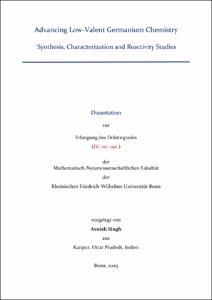
Advancing Low-Valent Germanium ChemistrySynthesis, Characterization and Reactivity Studies

Advancing Low-Valent Germanium Chemistry
Synthesis, Characterization and Reactivity Studies
| dc.contributor.advisor | Filippou, Alexander C. | |
| dc.contributor.author | Singh, Avnish | |
| dc.date.accessioned | 2026-03-30T14:00:57Z | |
| dc.date.available | 2026-03-30T14:00:57Z | |
| dc.date.issued | 30.03.2026 | |
| dc.identifier.uri | https://hdl.handle.net/20.500.11811/14029 | |
| dc.description.abstract | A central objective of modern inorganic chemistry is the "gram-scale synthesis" and comprehensive characterization of low-valent main-group compounds with unusual bonding motifs. Such species provide important insight into the nature of chemical bonding and challenge established concepts. Their isolation requires carefully designed synthetic strategies, suitable precursors, and sterically demanding substituents that confer kinetic stabilization to otherwise highly reactive intermediates. Among these, the heavier alkyne analogues, ditetrelynes (E2R2; E = Si, Ge, Sn), represent a prominent class. These compounds feature trans-bent geometries, narrow HOMO–LUMO gaps (~2 eV), and pronounced diradical character, which governs their distinctive reactivity. As a result, ditetrelynes have emerged as versatile platforms for small-molecule activation, C–C bond formation, and catalytic transformations. This work highlights the synthetic potential of Sn2ArDipp2 towards metal carbonyls, affording unprecedented metallo-bis-stannylene complexes (2-Co and 2-Rh) featuring a low-valent Sn center. Furthermore, experimental investigation into the reactivity of a cis-bent digermyne complex (3-CoGe) with non-polar unsaturated substrates affords unsaturated-metallacycles via diverse pathways, including addition (3-Co), cycloaddition (4-Co to 7-Co) and insertion reactions (8-Co to 10-Co), culminating in the formation of a novel digermatetraphospha dewar benzene complex (11-Co). Building on these findings, a comparative investigation of homonuclear ditetrelynes (TbbE≡ETbb, E = Si, Ge) with polar and non-polar unsaturated molecules provides the isolation of the first examples of reductive coupling of Mes-NC at low-valent Si (12-Si) and Ge (12-Ge) centers in the +1-oxidation state, yielding 1,2-disiletene and 1,2-digermetene species upon reaction with polar reagent like Mes-NC. In contrast, Ge2Tbb2 reacts with a non-polar substrate, 2-butyne, to form 1,2-digermabutadiene, which undergoes diverse downstream transformations to give germylone (19-Ge), stannylone (19-Ge) and an unprecedented η5-Ge(0) half-sandwich complex (23-Ge). Extension to heteroditetrelyne chemistry enables the synthesis of unprecedented stannasilyne, including DMAP-supported (25-SnSi), Mes-NC-supported (26-SnSi) and IMe4-supported (27-SnSi) derivatives, with the latter two representing the first reactivity studies of DMAP-supported stannasilyne (25-SnSi). Attempt to access base-free silyne instead led to the unexpected formation of a novel bis-ligand-supported silasiliryne (35-Si). Finally, the reaction of a sterically less demanding diazoolefin with (E)-(Tbb)BrSi=SiBr(Tbb) yields a cyclic bis-silyl amide (38-Si). Whereas the corresponding Ge analogue affords the first NHC-supported germyne (39-Ge) bearing a bulky Tbb substituent at a dicoordinated Ge-center. Notably, reductive dehalogenation of the cyclic bis-silyl amide (38-Si) with KC8 furnishes an unprecedented heavier imidazole derivative (40-Si). | en |
| dc.language.iso | eng | |
| dc.rights | In Copyright | |
| dc.rights.uri | http://rightsstatements.org/vocab/InC/1.0/ | |
| dc.subject | low-valent | |
| dc.subject | heavier main group | |
| dc.subject | unsaturated-metallacycle | |
| dc.subject | isocyanide coupling | |
| dc.subject | germylone | |
| dc.subject | stannylone | |
| dc.subject | half-sandwich complex | |
| dc.subject | heteroditetrelyne | |
| dc.subject | stannasilyne | |
| dc.subject | silasiliryne | |
| dc.subject | diazoolefin | |
| dc.subject | bis-silyl amide | |
| dc.subject | germyne | |
| dc.subject | heavier imidazole | |
| dc.subject | disilyne | |
| dc.subject | digermyne | |
| dc.subject | distannyne | |
| dc.subject | diradicaloid | |
| dc.subject | bis-silylidene | |
| dc.subject | bis-germylidene | |
| dc.subject | CAAC | |
| dc.subject | NHC | |
| dc.subject.ddc | 540 Chemie | |
| dc.title | Advancing Low-Valent Germanium Chemistry | |
| dc.title.alternative | Synthesis, Characterization and Reactivity Studies | |
| dc.type | Dissertation oder Habilitation | |
| dc.identifier.doi | https://doi.org/10.48565/04ye-xw02 | |
| dc.publisher.name | Universitäts- und Landesbibliothek Bonn | |
| dc.publisher.location | Bonn | |
| dc.rights.accessRights | openAccess | |
| dc.identifier.urn | https://nbn-resolving.org/urn:nbn:de:hbz:5-89086 | |
| ulbbn.pubtype | Erstveröffentlichung | |
| ulbbnediss.affiliation.name | Rheinische Friedrich-Wilhelms-Universität Bonn | |
| ulbbnediss.affiliation.location | Bonn | |
| ulbbnediss.thesis.level | Dissertation | |
| ulbbnediss.dissID | 8908 | |
| ulbbnediss.date.accepted | 16.03.2026 | |
| ulbbnediss.institute | Mathematisch-Naturwissenschaftliche Fakultät : Fachgruppe Chemie / Institut für Anorganische Chemie | |
| ulbbnediss.fakultaet | Mathematisch-Naturwissenschaftliche Fakultät | |
| dc.contributor.coReferee | Bismuto, Alessandro | |
| ulbbnediss.contributor.orcid | https://orcid.org/0009-0004-9848-2526 |
Dateien zu dieser Ressource
Das Dokument erscheint in:
-
E-Dissertationen (4581)
Die folgenden Nutzungsbestimmungen sind mit dieser Ressource verbunden: