

Photoswitchable Ligands Enable Thermodynamic Disequilibration of Metal-Organic Assemblies

Photoswitchable Ligands Enable Thermodynamic Disequilibration of Metal-Organic Assemblies
| dc.contributor.advisor | von Krbek, Larissa K. S. | |
| dc.contributor.author | Notheis, Maximilian Johannes | |
| dc.date.accessioned | 2026-04-14T08:04:23Z | |
| dc.date.available | 2026-04-14T08:04:23Z | |
| dc.date.issued | 14.04.2026 | |
| dc.identifier.uri | https://hdl.handle.net/20.500.11811/14099 | |
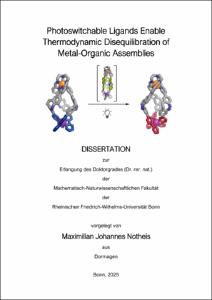
| dc.description.abstract | Living organisms need a constant supply of energy to sustain life. The molecular reason for this can be found in the operating mechanism of biological systems that perform extraordinary functions like absorbing nutrients and distributing them across the organism, self-healing, movement, and reproduction. These intricate biological systems do not reside in the thermodynamic minimum. Instead, a constant energy supply is needed to sustain meta-stable states far away from the thermodynamic minimum. The innate energy of these states is harnessed to perform work, enabling the complex behaviors of living organisms. A fundamental understanding of how to access and sustain meta-stable states in artificial systems and materials is a step towards extending life-like behaviors to inanimate objects, opening numerous perspectives from more sustainable self-repairing materials to medical applications in targeted drug release. Systems making use of phase boundaries to stabilize meta-stable states such as dynamic droplets and nanocrystals have recently been described in literature. However, the systematic use of dynamic and reversible metal-ligand interactions to stabilize meta-stable states remains an underexplored approach. This dissertation establishes light-driven reaction networks, specifically energy ratchets, as a foundational mechanism to accumulate meta-stable states in self-assembled metal-organic structures. Furthermore, it explores how the innate energy of the meta-stable state can be harnessed in enabling macroscale spatio-temporal control over nanoscale chemical transformations. Initial work focused on the design, synthesis and investigation of photoresponsive building blocks. Firstly, a family of novel twelve-membered macrocyclic azobenzenes was investigated, yielding new insights on using backbone flexibility to tune photochromic properties. Secondly, a reliable gram‑scale synthesis of 2,8-dihalogenated diazocine was established. This was followed by selective, stepwise Suzuki couplings to access asymmetrically functionalized diazocine building blocks that combine a large geometry change during switching with favorable photochemical properties. A one-pot sub-component self-assembly using one of the tailor-made building blocks resulted in selective formation of high-fidelity, low-symmetry, heterobimetallic helicates. The final structure contains two distinct coordination sites, enabling quantitative formation of self-sorted Fe/Zn and Zn/Co heterobimetallic helicates. The precise metal distribution is enabled by a complex reaction network during self-assembly that amplifies differences in metal-ligand bond strength and exchange kinetics. This separates the metals into the two coordination sites as a result of kinetic and thermodynamic factors. Investigating the photoresponsive behavior of the helicates revealed a light-driven energy-ratchet mechanism. Photoisomerization of the diazocine units transiently reshapes the assemblies' energy landscape, enabling rapid reconfiguration of the initial structure into a mixture of metastable isomeric states. These become kinetically trapped upon back-isomerization, enabling the accumulation of meta-stable high-energy atropisomers. Continuous white-light irradiation operates the energy ratchet autonomously by exciting both switching transitions simultaneously. This amplifies a minor photostationary state into a dominant, long-lived meta-stable diastereomer. Additionally, operation of the ratchet accelerates regioselective metal-cation exchange (Zn2L → ZnFeL), providing spatiotemporal control over selective metal ion capture. Nature shows us that complex behavior is a result of complex systems. The incorporation of energy ratchets into metal-organic cages elevates them into a realm of complexity that is usually reserved for enzymes. These results pave the way towards larger photoresponsive cages for molecular machines that operate under out‑of‑equilibrium conditions, thus enabling life-like behaviors such as controlled catalysis, active transport, or macroscale directed movement. | en |
| dc.language.iso | eng | |
| dc.rights | In Copyright | |
| dc.rights.uri | http://rightsstatements.org/vocab/InC/1.0/ | |
| dc.subject | Chemie | |
| dc.subject | Fotoschalter | |
| dc.subject | Metallorganisch | |
| dc.subject | Käfige | |
| dc.subject | Chemistry | |
| dc.subject | Photoswitch | |
| dc.subject | metal-organic | |
| dc.subject | cage | |
| dc.subject.ddc | 540 Chemie | |
| dc.title | Photoswitchable Ligands Enable Thermodynamic Disequilibration of Metal-Organic Assemblies | |
| dc.type | Dissertation oder Habilitation | |
| dc.publisher.name | Universitäts- und Landesbibliothek Bonn | |
| dc.publisher.location | Bonn | |
| dc.rights.accessRights | openAccess | |
| dc.identifier.urn | https://nbn-resolving.org/urn:nbn:de:hbz:5-89577 | |
| dc.relation.doi | https://doi.org/10.1039/D3OB00413A | |
| dc.relation.doi | https://doi.org/10.1055/a-2567-1399 | |
| dc.relation.doi | https://doi.org/10.1002/anie.202508952 | |
| ulbbn.pubtype | Erstveröffentlichung | |
| ulbbnediss.affiliation.name | Rheinische Friedrich-Wilhelms-Universität Bonn | |
| ulbbnediss.affiliation.location | Bonn | |
| ulbbnediss.thesis.level | Dissertation | |
| ulbbnediss.dissID | 8957 | |
| ulbbnediss.date.accepted | 31.03.2026 | |
| ulbbnediss.institute | Mathematisch-Naturwissenschaftliche Fakultät : Fachgruppe Chemie / Kekulé-Institut für Organische Chemie und Biochemie | |
| ulbbnediss.fakultaet | Mathematisch-Naturwissenschaftliche Fakultät | |
| dc.contributor.coReferee | Lützen, Arne | |
| ulbbnediss.contributor.orcid | https://orcid.org/0000-0002-7730-6433 |
Dateien zu dieser Ressource
Das Dokument erscheint in:
-
E-Dissertationen (4581)
Die folgenden Nutzungsbestimmungen sind mit dieser Ressource verbunden: