

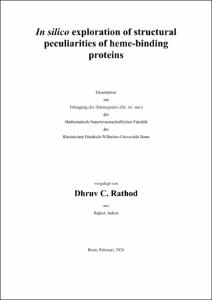
In silico exploration of structural peculiarities of heme-binding proteins

In silico exploration of structural peculiarities of heme-binding proteins
| dc.contributor.advisor | Imhof, Diana | |
| dc.contributor.author | Rathod, Dhruv C. | |
| dc.date.accessioned | 2026-05-22T10:35:36Z | |
| dc.date.available | 2026-05-22T10:35:36Z | |
| dc.date.issued | 22.05.2026 | |
| dc.identifier.uri | https://hdl.handle.net/20.500.11811/14163 | |
| dc.description.abstract | Exponential gains in computing and AI have reshaped biochemical research, enabling pathways-level reasoning and atomistic simulation of proteins. Among small-molecule effectors, labile heme is distinctive as it can impair signaling pathways to varying degrees. This dissertation focuses on transient heme-protein interactions and its detrimental consequences, using modern computational tools, such as molecular docking, molecular dynamics (MD), and knowledge-graph (KG) approaches to accompany the experimental work. As a starting point, peptide models and structure-based analyses were used to explore sequential and conformational features of heme-binding sites in mammalian proteins. The study identified distinct N-terminal sequence patterns around heme-binding motifs (HBMs) and showed that CP motifs are mainly occurring in flexible loop/linker regions, while C motifs are typically in longer flexible loops and H/Y motifs are more often embedded within α-helices or β-sheets. These rules provide a practical guideline summarizing the characteristics for motif identification in yet unknown heme-binding proteins to testable hypotheses. This work formed the basis for many studies on potential protein targets, one example representing the Toll-like receptor 4 (TLR4). Mapping and validating candidate HBMs revealed multiple interaction sites and a cofactor regime different from that of the known natural activator lipopolysaccharide (LPS), whose binding to TLR4 is the key event of the innate immune system in recognizing Gram-negative bacteria. It was hence found that heme activates inflammatory TLR4 signaling in human immune cells primarily through direct interactions with TLR4 and can do so largely independently of other interaction partners, highlighting a distinct activation mechanism from LPS. To connect local signaling events to system behavior, the recently established TLR4-focused HemeKG was updated. Newly curated computable relations and missing downstream components, such as AP-1, IL-12, CD80/86, and CXCL1, were added and confirmed TLR4 pathway enrichment in accordance with the signaling databases KEGG, Reactome, and WikiPathways. Finally, two approaches to model protein structures were comparably analyzed, namely AlphaFold (AF) and homology modeling (HM). While, AF provides excellent folds but can mislead at flexible, ligand-exposed pockets, HM often yields more realistic local geometry for docking and motif pattern recognition, motivating local confidence metrics and pocket chemistry checks to assist experimental work. Together, these advances show how computational approaches can convert atom-level heme recognition data into pathway-level insight to contribute to our understanding of heme's action as an effector molecule in pathological conditions. | en |
| dc.language.iso | eng | |
| dc.rights | In Copyright | |
| dc.rights.uri | http://rightsstatements.org/vocab/InC/1.0/ | |
| dc.subject | Häm | |
| dc.subject | Hämolyse | |
| dc.subject | Transiente Häm-Protein-Interaktionen | |
| dc.subject | Häm-Bindungsmotive (HBMs) | |
| dc.subject | TLR4 | |
| dc.subject | Wissensgraphen | |
| dc.subject | Molekulares Docking und Molekulardynamik-Simulationen | |
| dc.subject | AlphaFold | |
| dc.subject | Homologiemodellierung | |
| dc.subject | Heme | |
| dc.subject | Hemolysis | |
| dc.subject | Transient heme-protein interactions | |
| dc.subject | Heme-binding motifs (HBMs) | |
| dc.subject | TLR4 | |
| dc.subject | Knowledge graphs | |
| dc.subject | Molecular docking and dynamics simulations | |
| dc.subject | Homology modeling | |
| dc.subject.ddc | 004 Informatik | |
| dc.subject.ddc | 500 Naturwissenschaften | |
| dc.subject.ddc | 615 Pharmakologie, Therapeutik | |
| dc.title | In silico exploration of structural peculiarities of heme-binding proteins | |
| dc.type | Dissertation oder Habilitation | |
| dc.identifier.doi | https://doi.org/10.48565/bonndoc-869 | |
| dc.publisher.name | Universitäts- und Landesbibliothek Bonn | |
| dc.publisher.location | Bonn | |
| dc.rights.accessRights | openAccess | |
| dc.identifier.urn | https://nbn-resolving.org/urn:nbn:de:hbz:5-90207 | |
| dc.relation.doi | https://doi.org/10.3390/biom13071031 | |
| dc.relation.doi | https://doi.org/10.1111/imm.13708 | |
| dc.relation.doi | https://doi.org/10.1016/j.jinorgbio.2025.113040 | |
| dc.relation.doi | https://doi.org/10.3390/ph16121662 | |
| ulbbn.pubtype | Erstveröffentlichung | |
| ulbbnediss.affiliation.name | Rheinische Friedrich-Wilhelms-Universität Bonn | |
| ulbbnediss.affiliation.location | Bonn | |
| ulbbnediss.thesis.level | Dissertation | |
| ulbbnediss.dissID | 9020 | |
| ulbbnediss.date.accepted | 29.04.2026 | |
| ulbbnediss.institute | Mathematisch-Naturwissenschaftliche Fakultät : Fachgruppe Pharmazie / Pharmazeutisches Institut | |
| ulbbnediss.fakultaet | Mathematisch-Naturwissenschaftliche Fakultät | |
| dc.contributor.coReferee | Biswas, Arijit | |
| ulbbnediss.contributor.orcid | https://orcid.org/0000-0003-2369-5768 | |
| ulbbnediss.contributor.gnd | 1402671431 |
Dateien zu dieser Ressource
Das Dokument erscheint in:
-
E-Dissertationen (4584)
Die folgenden Nutzungsbestimmungen sind mit dieser Ressource verbunden: