

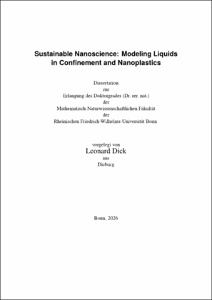
Sustainable Nanoscience: Modeling Liquids in Confinement and Nanoplastics

Sustainable Nanoscience: Modeling Liquids in Confinement and Nanoplastics
| dc.contributor.advisor | Kirchner, Barbara | |
| dc.contributor.author | Dick, Leonard | |
| dc.date.accessioned | 2026-08-05T12:50:56Z | |
| dc.date.available | 2026-08-05T12:50:56Z | |
| dc.date.issued | 05.08.2026 | |
| dc.identifier.uri | https://hdl.handle.net/20.500.11811/14362 | |
| dc.description.abstract | As the global demand for electric power surges and the transition away from fossil fuels continues, developing optimized energy storage systems has become increasingly important. The optimization of electrode materials and electrolytes is central to maximizing storage efficiency. In this context, nanoporous materials, such as porous carbons, carbon nanotubes and metal-organic frameworks have gained significant attention. The geometry of their porous networks governs the structure and dynamics of the confined electrolytes and is fundamental to consider for further optimizations of electrode-electrolyte systems. At the same time, nanoplastics have become ubiquitous in the environment over the past decades. The particles primarily arise from tire abrasion, mechanical wear of textiles and degradation of macroplastics improperly disposed of. While the long term toxicological impacts on human health are not yet fully understood, recent studies show that nanoplastics can cross various biological barriers and have been found in the digestive tract, blood and even the brain. These findings underscore the need for further studies in this area and to establish new methods that provide further insight into how nanoplastics behave on a molecular level. Although the two topics do appear unrelated at first glance, both cover areas of nanoscience in which understanding the behavior of matter at an atomic resolution is key. This thesis relies on computational methods to model these systems and novel analysis methods and modeling approaches to advance the research in both fields are presented. The first part focuses on modeling liquids within nanoporous materials using molecular dynamics simulations. The liquids studied include ionic liquids, salt-in-ionic liquid mixtures, and water, while the nanoporous materials comprise carbon nanotubes of differing size and the metal-organic framework ZIF-8. In order to resolve the structure and dynamics of liquids of these highly anisotropic, solid–liquid systems, a main part of this thesis covers the development of a new analysis program, CONAN. It is an open-source software that focuses on the analysis of confinement effects impacting the structure and dynamics of confined liquids. Using CONAN, the structural features of ionic liquids and salt-in-ionic liquids in the confinement of sub-nanometer carbon nanotubes and the metal-organic framework ZIF-8 are analyzed relying on novel analysis tools. Furthermore, structural and dynamical properties of water in confinement of single, isolated carbon nanotubes and vertically aligned carbon nanotube arrays are discussed. Secondly, this thesis explores various methods for folding individual polymer strands into nanoplastic particles. The goal of this task lies in capturing the variability of nanoplastics found in the environment in terms of their structure and composition and to generate sets of relevant conformations. As these plastics consist of multiple, interwoven polymer strands which can fold into a myriad of possible conformers, a complete scan of the conformational space is computationally unfeasible. Instead, sets of nanoplastic structures are generated, evaluated, and provided as datasets for further research. In addition, nanoplastics readily aggregate with surrounding colloidal matter and organic molecules. This includes other pollutants such as antibiotics, which are increasingly prevalent in the environment. In this context, the adsorption of the antibiotic onto various types of nanoplastics is studied, and relevant nanoplastics and nanoplastic–tetracycline aggregate conformations are discussed. Furthermore, a novel approach for nanoplastic folding is presented that significantly expands the diversity of accessible nanoplastic structures. | en |
| dc.language.iso | eng | |
| dc.rights | In Copyright | |
| dc.rights.uri | http://rightsstatements.org/vocab/InC/1.0/ | |
| dc.subject | molecular dynamics | |
| dc.subject | theoretical chemistry | |
| dc.subject.ddc | 540 Chemie | |
| dc.title | Sustainable Nanoscience: Modeling Liquids in Confinement and Nanoplastics | |
| dc.type | Dissertation oder Habilitation | |
| dc.identifier.doi | https://doi.org/10.48565/bonndoc-930 | |
| dc.publisher.name | Universitäts- und Landesbibliothek Bonn | |
| dc.publisher.location | Bonn | |
| dc.rights.accessRights | openAccess | |
| dc.identifier.urn | https://nbn-resolving.org/urn:nbn:de:hbz:5-91472 | |
| dc.relation.doi | https://doi.org/10.1021/acs.jcim.3c01075 | |
| dc.relation.doi | https://doi.org/10.1021/acs.jpcb.3c08493 | |
| dc.relation.doi | https://doi.org/10.1021/acs.jpcb.5c01702 | |
| dc.relation.doi | https://doi.org/10.1021/acsnano.5c17458 | |
| dc.relation.doi | https://doi.org/10.1038/s41598-024-75785-4 | |
| dc.relation.doi | https://doi.org/10.1021/acs.jpcb.5c06528 | |
| dc.relation.doi | https://doi.org/10.1021/acs.jpclett.6c01194 | |
| ulbbn.pubtype | Erstveröffentlichung | |
| ulbbnediss.affiliation.name | Rheinische Friedrich-Wilhelms-Universität Bonn | |
| ulbbnediss.affiliation.location | Bonn | |
| ulbbnediss.thesis.level | Dissertation | |
| ulbbnediss.dissID | 9147 | |
| ulbbnediss.date.accepted | 09.07.2026 | |
| ulbbnediss.institute | Mathematisch-Naturwissenschaftliche Fakultät : Fachgruppe Chemie / Institut für Physikalische und Theoretische Chemie | |
| ulbbnediss.fakultaet | Mathematisch-Naturwissenschaftliche Fakultät | |
| dc.contributor.coReferee | Bredow, Thomas | |
| ulbbnediss.contributor.orcid | https://orcid.org/0000-0002-5596-9498 | |
| ulbbnediss.contributor.gnd | 1415610185 |
Dateien zu dieser Ressource
Das Dokument erscheint in:
-
E-Dissertationen (4613)
Die folgenden Nutzungsbestimmungen sind mit dieser Ressource verbunden: