
Browsing by Author "Wägele, Johann Wolfgang"
Now showing items 1-20 of 23
-
Bee Diversity and some Aspects of their Ecological Interactions with Plants in a Successional Tropical Community
(2006)This study aimed at establishing bee diversity and some aspects of their interactions with plants along a forest regeneration gradient in Kakamega Forest. To determine the bee diversity, bee samples were collected with the ... -
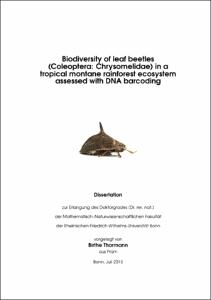
Biodiversity of leaf beetles (Coleoptera: Chrysomelidae) in a tropical montane rainforest ecosystem assessed with DNA barcoding
(2016-08-09)The aim of the present study was the assessment of an unknown tropical insect fauna without traditional taxonomy. For this purpose, the diversity of leaf beetles (Coleoptera: Chrysomelidae) in the montane rainforest of the ... -
Development of workflows for metabarcoding of mass-samples: A case study on Diptera
(2020-02-14)The main goal was developing a workflow for comprehensive biodiversity monitoring using a DNA Barcoding approach. As one of the major insect groups in the Palearctic the diverse order of Diptera served as an experimental ... -
Development, Ecology and Molecular Species Identification of Corpse-Associated Calliphoridae (Diptera): Consequences for Estimating the Post-Mortem Interval
(2010-07-07)Forensic entomology is the application of entomological knowledge in processing forensic cases involving arthropod infested corpses. The question arising most frequently concerns the estimation of a post-mortem interval ... -
DNA barcoding & multi-isotopic fingerprinting: a novel forensic toolbox for the rapid identification of illegal trade in endangered wildlife species
(2012-05-08)Over-exploitation through illegal wildlife trade is a major threat to a wide range of endangered mammal species around the world, particularly to the Felidae. Illegal trade in wild cats is often in the form of bones, meat, ... -
Ecology, biogeography and responses to habitat degradation of a highly diverse rainforest ant community and taxonomy of Afrotropical Pheidole Westwood (Hymenoptera, Formicidae)
(2012-11-23)This thesis is about the Kakamega Forest ant fauna in Kenya. With currently 329 ant species the region is the most diverse ever sampled in Africa and, in terms of altitude and biogeographic distribution, probably also one ... -
Effects of fragmentation and degradation of an afrotropical rain forest on the diversity structure of leaf beetle communities (Coleoptera, Chrysomelidae)
(2005)East African forests are particularly diverse and endangered but are still little-known ecosystems. With an increase of the human population in East Africa throughout the last decades, the pressure on biodiversity largely ... -
Evolutionary history of Southern Arabian faunal elements with a special focus on habitat fragmentation of two model organisms, Reissita simonyi (REBEL, 1899; Lepidoptera: Zygaenidae) and Hyla savignyi (AUDOUIN, 1827; Amphibia: Hylidae)
(2006)Habitat fragmentation is assumed to be one of the major factors for genetic separation of populations. Natural fragmentation of habitats may be caused by climatic changes and their consequences (e. g. desertification), as ... -
First revision of the family Metarbelidae Strand, 1909 (Lepidoptera, Cossoidea Leach, 1815) and a phylogeny based on adult morphology of 60 genera from the Afrotropical and Oriental Region
(2019-08-19)This thesis represents the first revision of the family Metarbelidae Strand, 1909. The author's extensive research on Metarbelidae includes fieldwork made in nine lowland and montane forests of Kenya (1994–2008; 2015–2018) ... -
Forest fragmentation and plant-pollinator interactions in Western Kenya
(2006)Rain forest fragmentation can affect plant-pollinator interactions and the reproductive success of plant species. Understanding these consequences is a crucial component of conserving vulnerable ecosystems. <br /> In this ... -
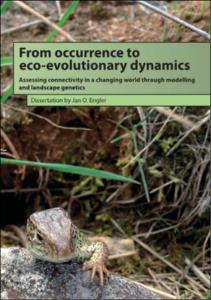
From occurrence to eco-evolutionary dynamics: Assessing connectivity in a changing world through modelling and landscape genetics
(2016-06-14)Climate change and the intensification of human land use are generally accepted as leading factors for global biodiversity loss, and their synergistic effects could make species loss even worse. In particular, habitat loss ... -
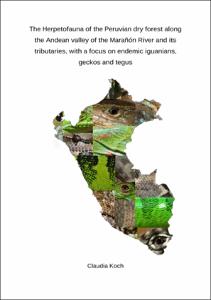
The Herpetofauna of the Peruvian dry forest along the Andean valley of the Marañón River and its tributaries, with a focus on endemic iguanians, geckos and tegus: Squamata: Iguanidae, Phyllodactylidae, Teiidae
(2014-02-27)The present study was organized to contribute to the knowledge of the herpetofauna of the Inter-Andean dry forest valleys. Several field surveys were conducted between July 2005 and November 2010 at 22 different localities ... -
Homology Assessment in Molecular Phylogenetics: Evaluation, Improvement, and Influence of Data Quality on Tree Reconstruction
(2012-01-12)Considering the final goal of every phylogenetic analysis, the reconstruction of taxon relationships from underlying data, little attention has been paid to the role of alignment accuracy and its impact on tree reconstruction. ... -
How to predict the future? On niches and potential distributions of amphibians and reptiles in a changing climate
(2009-11-11)The present Ph.D. thesis investigates relationships between variations in large scale climate, niches of amphibians and reptiles and their corresponding geographic distribution patterns. As suggested by several authors, ... -
Kammmolch - Monitoring - Krefeld: Populationsökologie einer europaweit bedeutsamen Population des Kammmolches (Triturus cristatus) unter besonderer Berücksichtigung naturschutzrelevanter Fragestellungen
(2010-07-01)Im Rahmen des, sich über drei Untersuchungsjahre erstreckenden Forschungs- und Naturschutzprojektes „Kammmolch – Monitoring – Krefeld“, wurde die Dynamik benachbarter Populationen des Kammmolches (Triturus cristatus), sowie ... -
Molecular insights to crustacean phylogeny
(2010-03-02)This thesis aims to resolve internal relationships of the major crustacean groups inferring phylogenies with molecular data. New molecular and neuroanatomical data support the scenario that the Hexapoda might have evolved ... -
Molekulare Phylogenie der Malariaerreger (Haemosporida) unter besonderer Berücksichtigung des Vogelmalariaerregers Plasmodium (Haemamoeba) cathemerium, sowie Untersuchungen zum Vorkommen der Vogelmalaria in Deutschland
(2006)Im Rahmen der vorliegenden Arbeit sollte erstmals mit Hilfe molekularbiologischer Methoden ein Einblick in die Infektionsprävalenz einheimischer Vögel mit Malariaerregern und das vorhandene Erregerspektrum gewonnen werden. ... -
Nutzung von Telemetrie- und Satellitendaten zur Identifizierung wichtiger Habitate wandernder Vogelarten (Ciconia ciconia, Aquila pomarina)
(2007)Während ihrer Wanderung nutzen Tiere vielfach unterschiedliche Biome, Klimazonen oder Habitate. Damit sind sie jedoch auch verschiedenen Gefahren ausgesetzt, die insbesondere aus der Vernichtung von Habitaten, Verfolgung ... -
Systematics and Biogeography of the African Scaly-tailed Squirrels (Mammalia: Rodentia: Anomaluridae)
(2005)The aim of the present investigation was a better understanding of the systematics and biogeography of the African scaly-tailed squirrels. Therefore 1581 anomalurid specimens from 22 collections were examined and data from ... -
Taxonomy and distributional pattern of Pimplinae (Hymenoptera: Ichneumonidae) from Vietnam
(2013-05-13)This monographic study of Vietnamese Pimplinae is based on several recent publications of the author that are integrated herein to a complete review.<br /> Although Vietnam is one of the global biodiversity hotspots, the ...